 LowestCode
Green AI Office and Business Application
by
One AI system, designed to replace
Microsoft Office, Microsoft Dynamics, Adobe, SAP and more.
One AI Workspace for Office & Business
With AI App Development Built In
In production since 2024 at an international insurance group: certified, due-diligence approved, and backed by the labor union. In the Quest, October to December 2026, one AI agent guided by one human creates an Office and Business App, with monthly, public, verifiable proof.
-
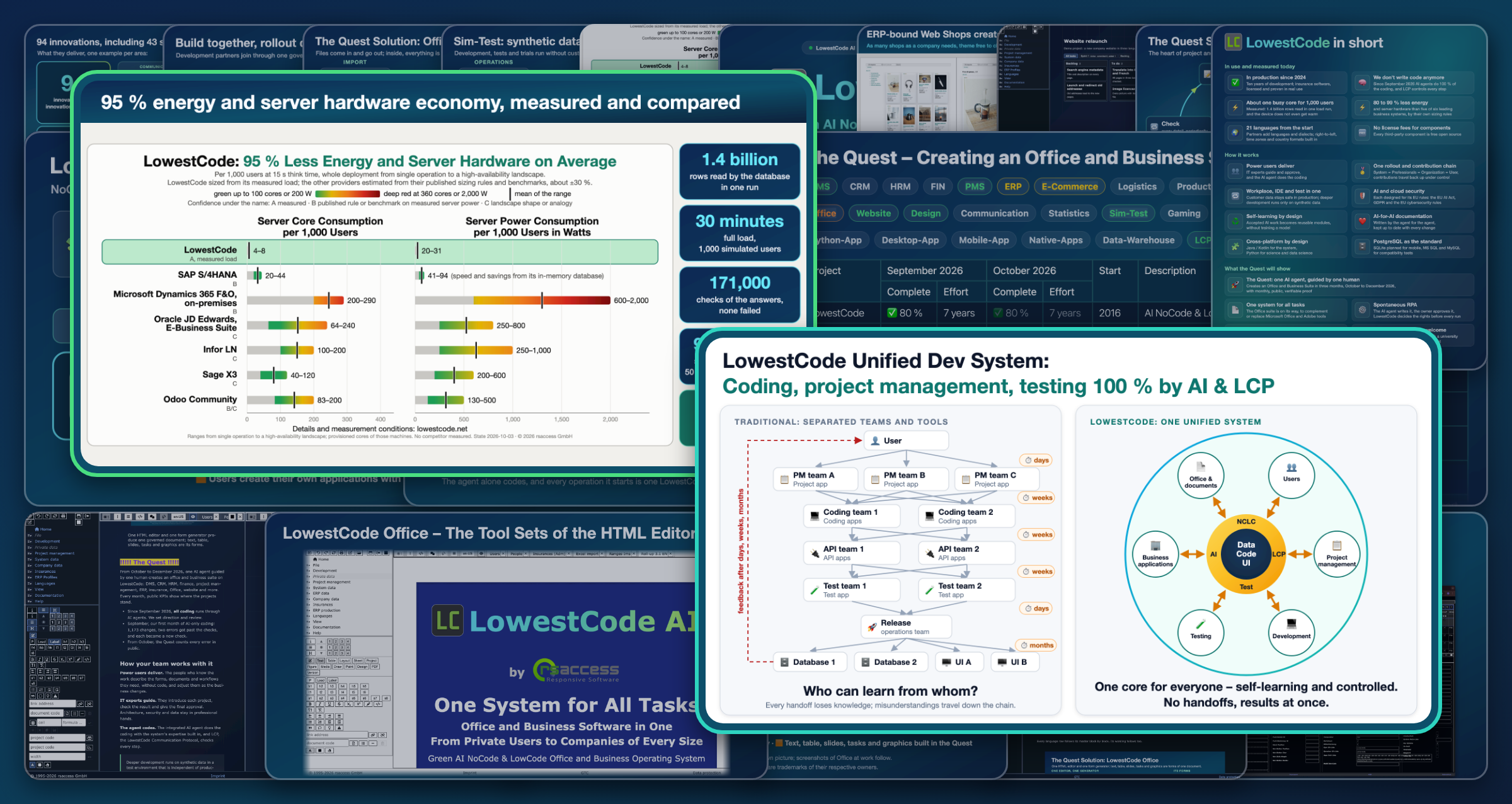 LowestCode at a glance: twenty pictures in one
-
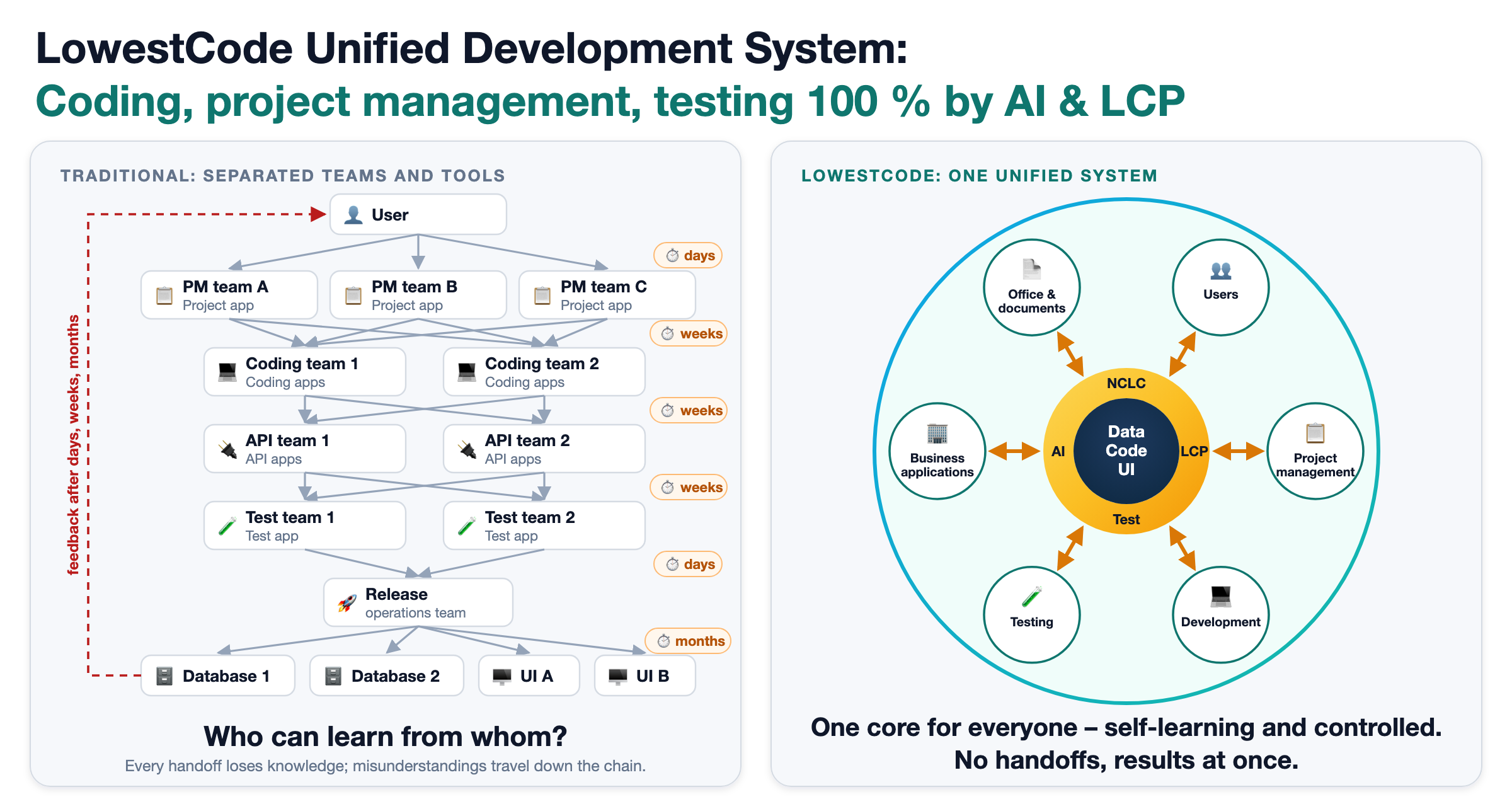 LowestCode Unified Development System:
Coding, project management, testing 100 % by AI & LCP -
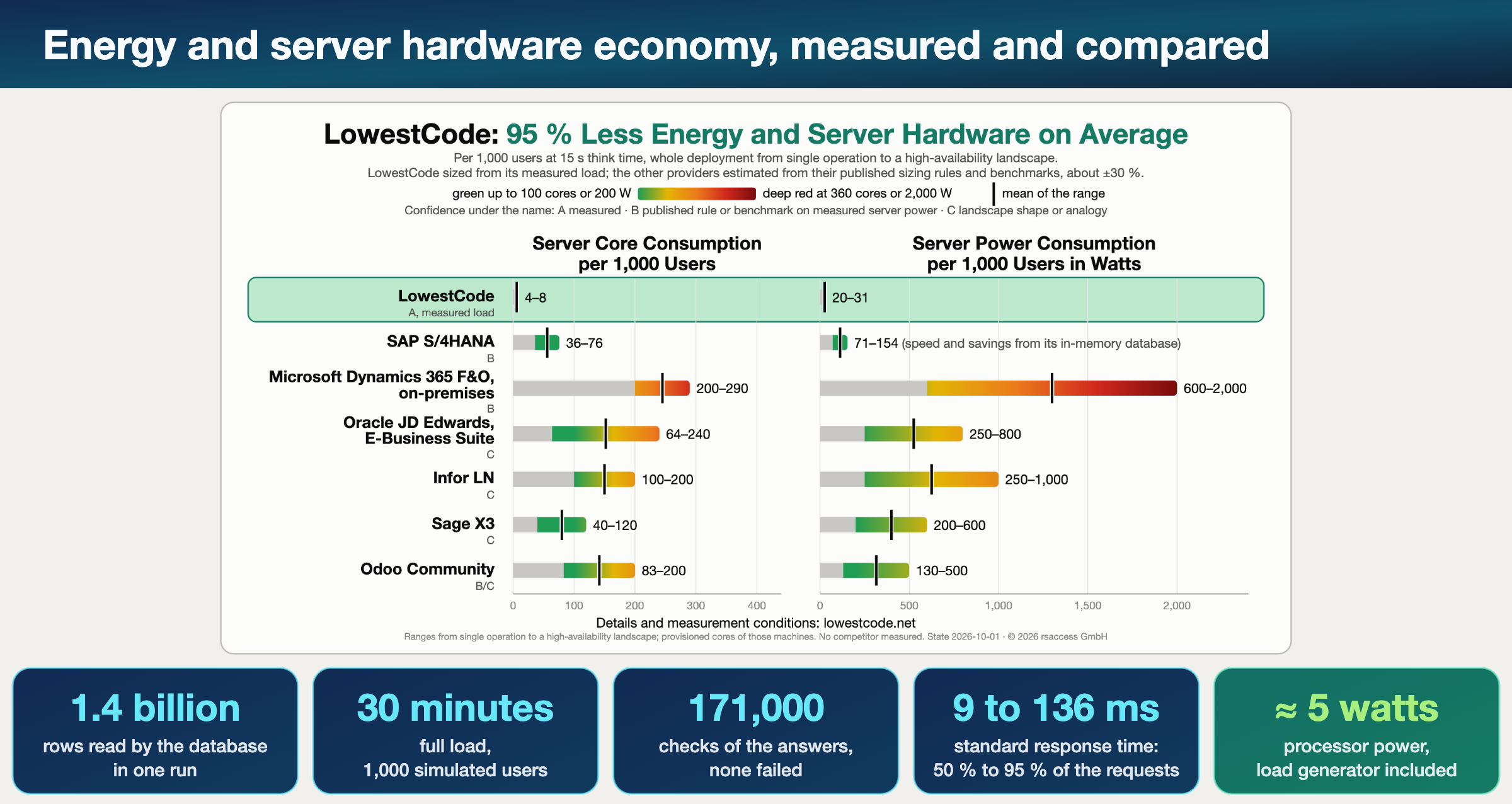 Energy and server hardware per 1,000 users
-
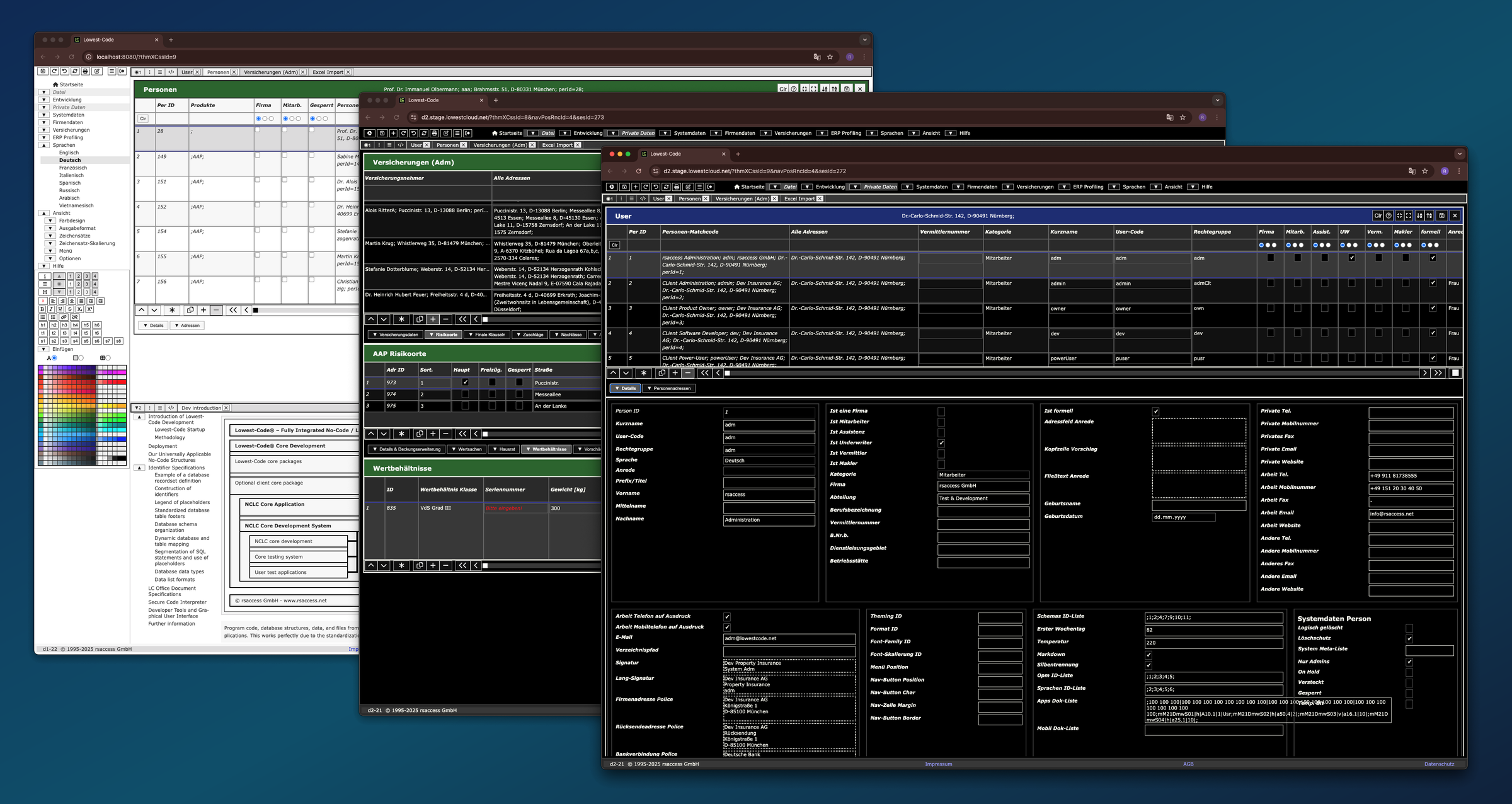 The workplace: several windows of one system side by side, in three themes
-
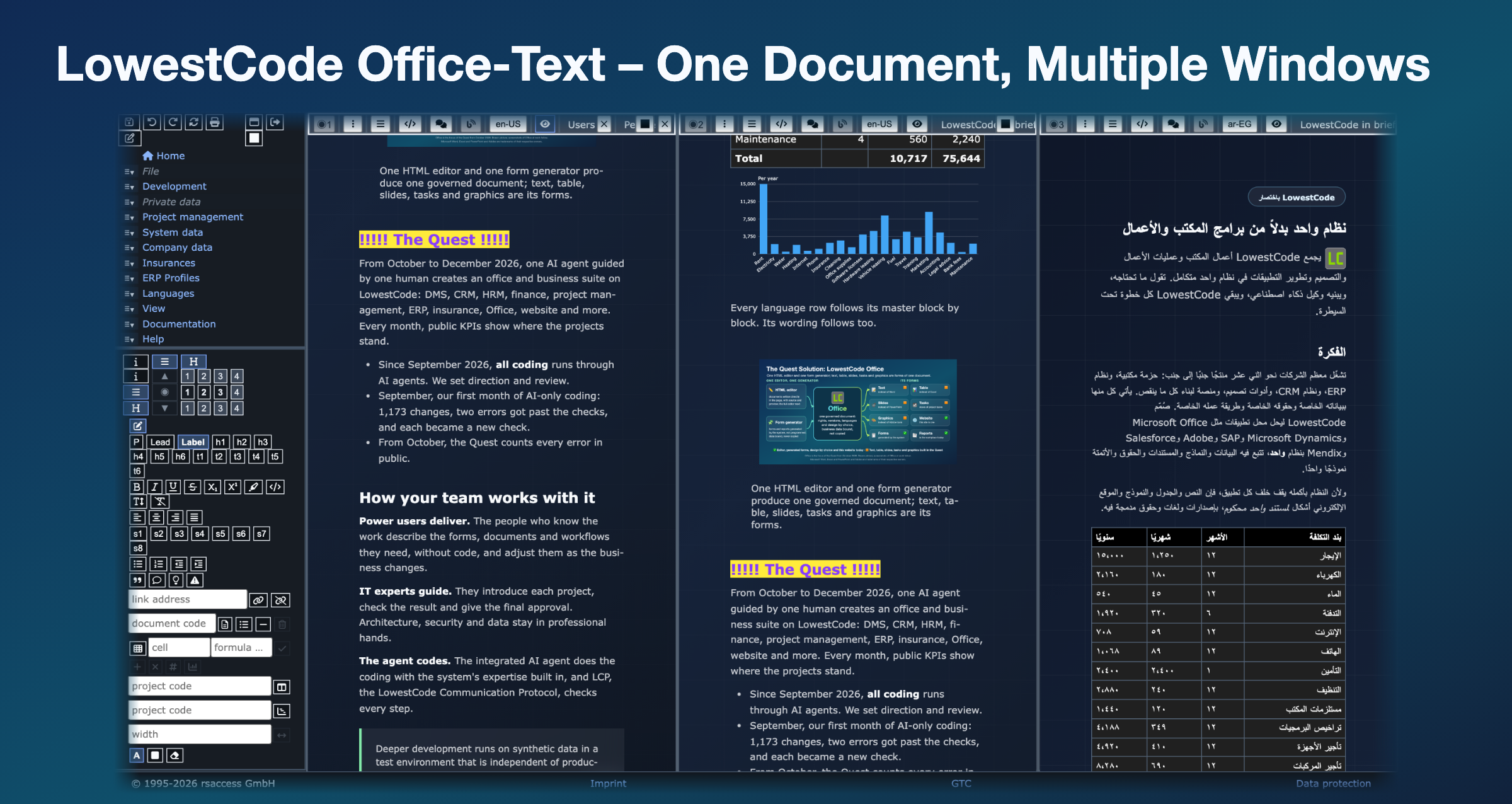 LowestCode Office-Text at work: one document in three windows, each scrolled on its own, built for full RPA
-
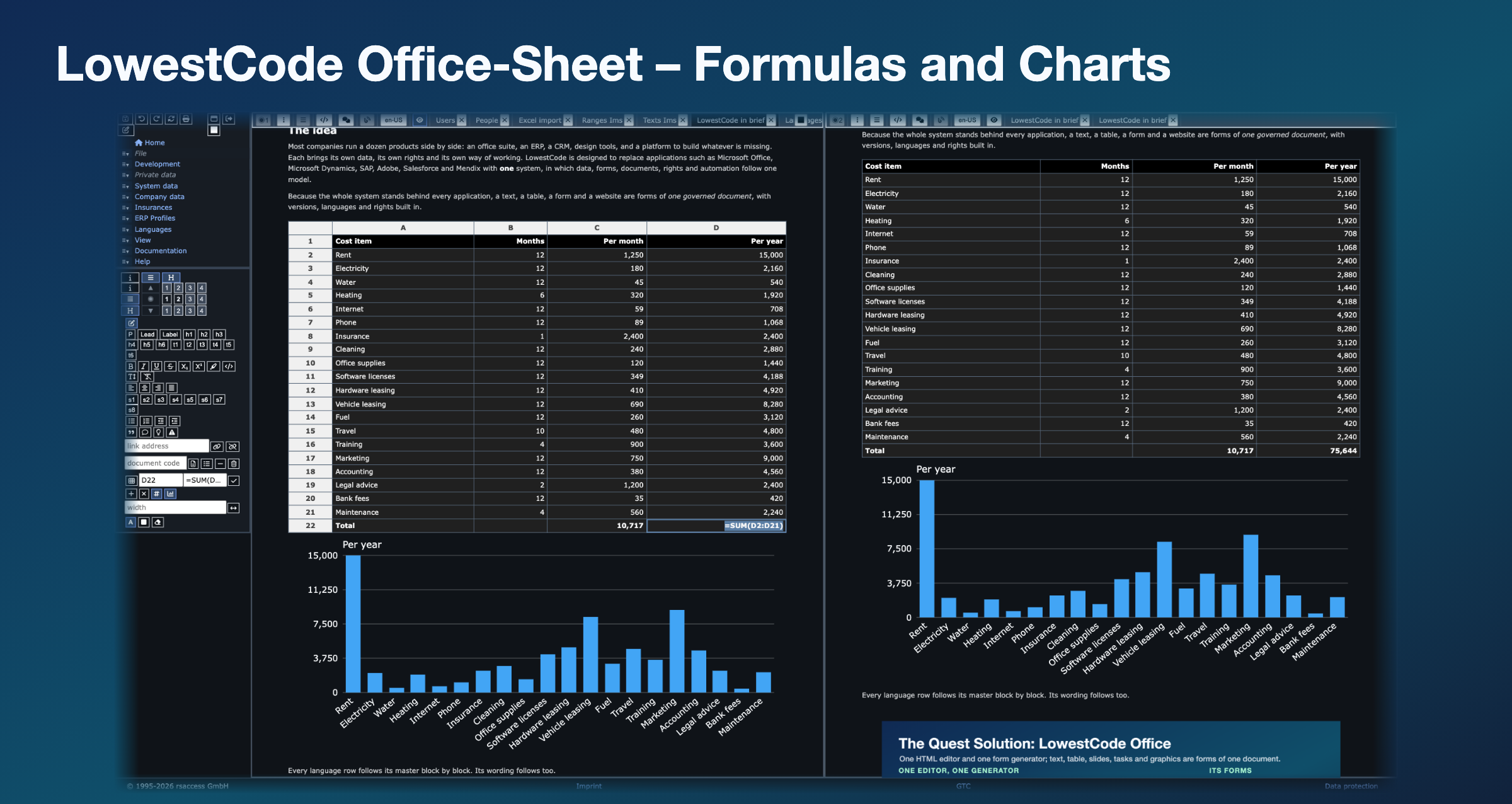 LowestCode Office-Sheet: a sheet with formulas and a chart inside the document, built for full RPA
-
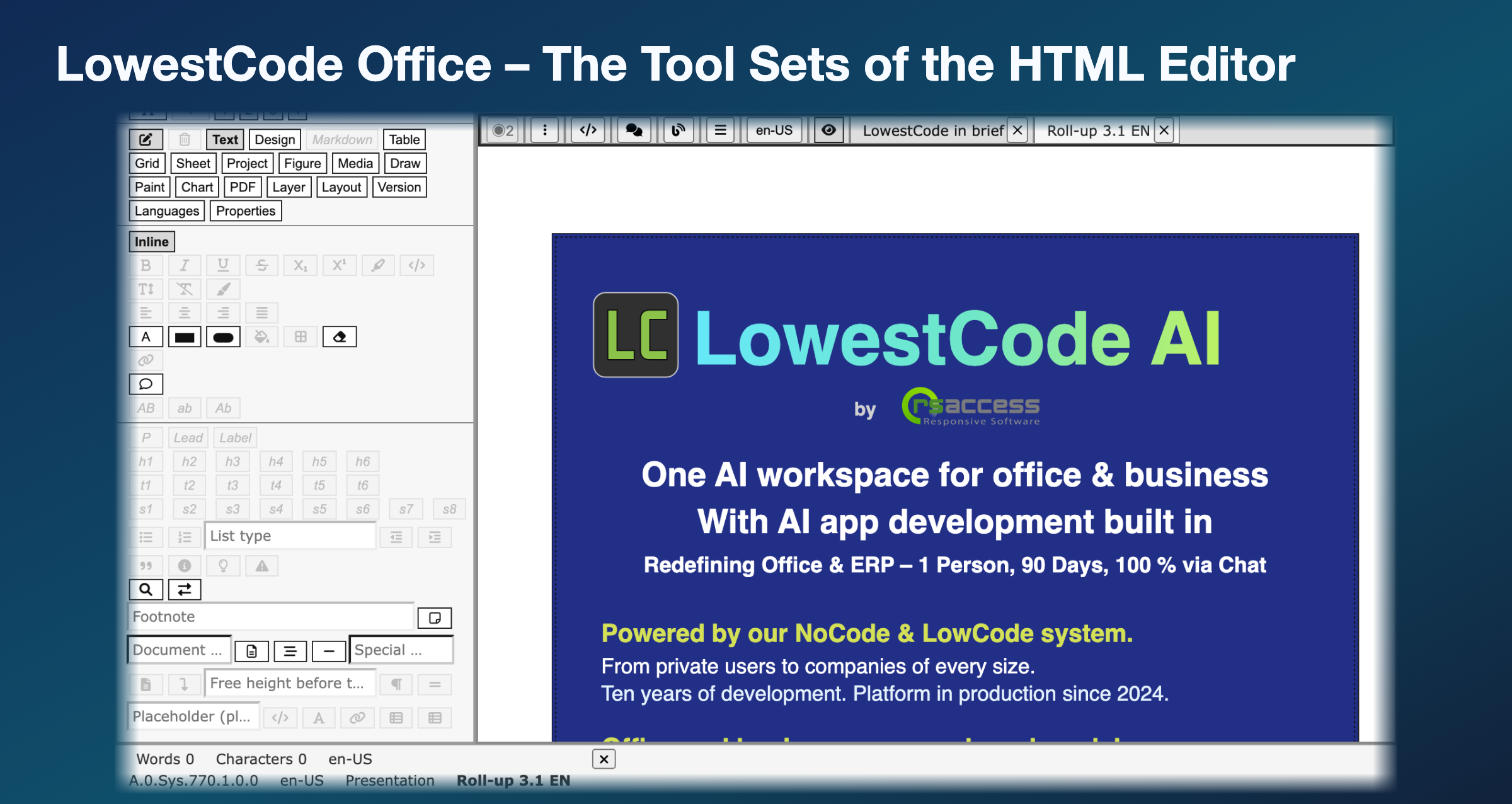 LowestCode Office tool sets: the tools of the HTML editor, active while a text is edited
-
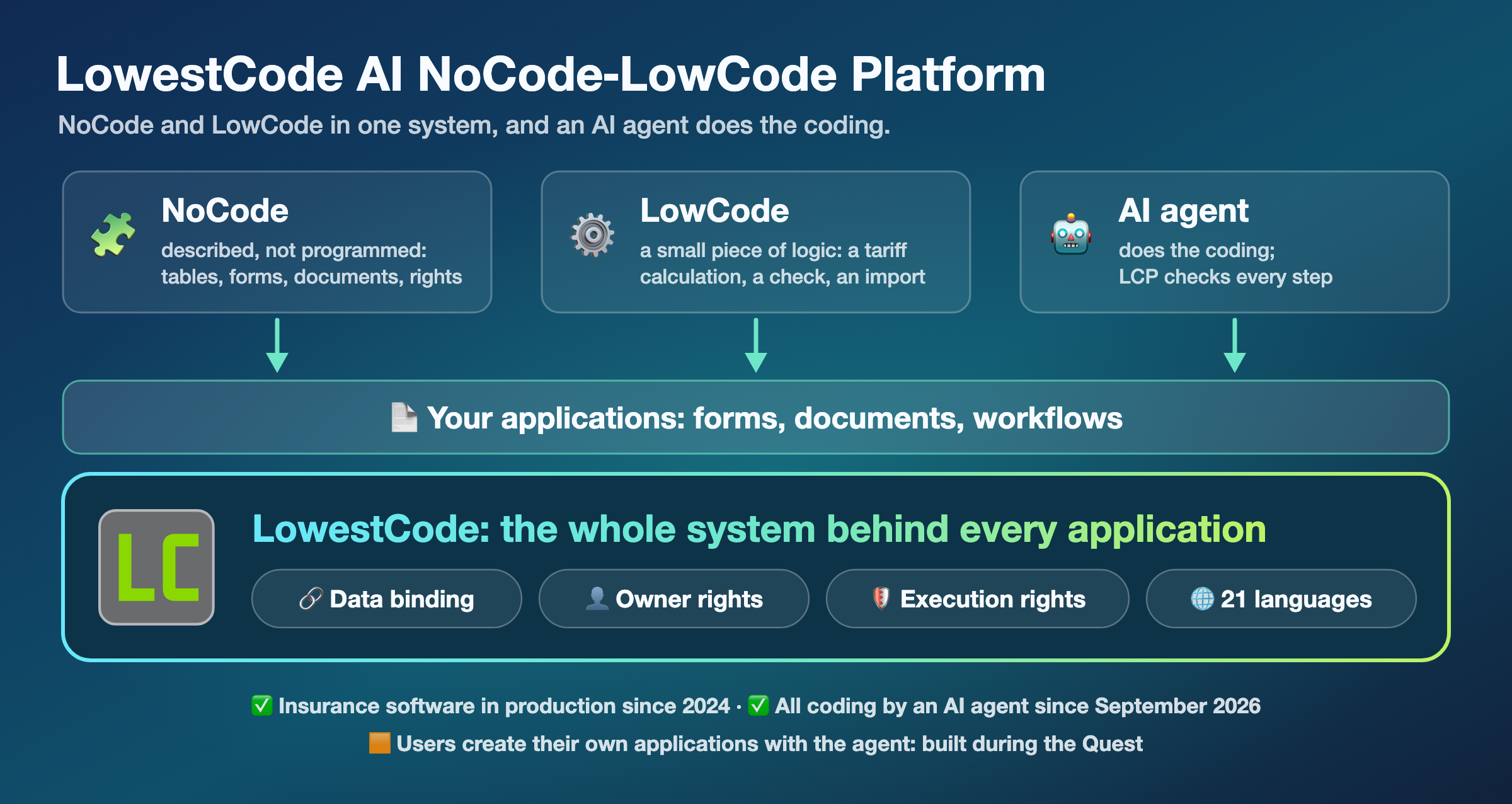 NoCode, LowCode and AI: the whole system behind every application
-
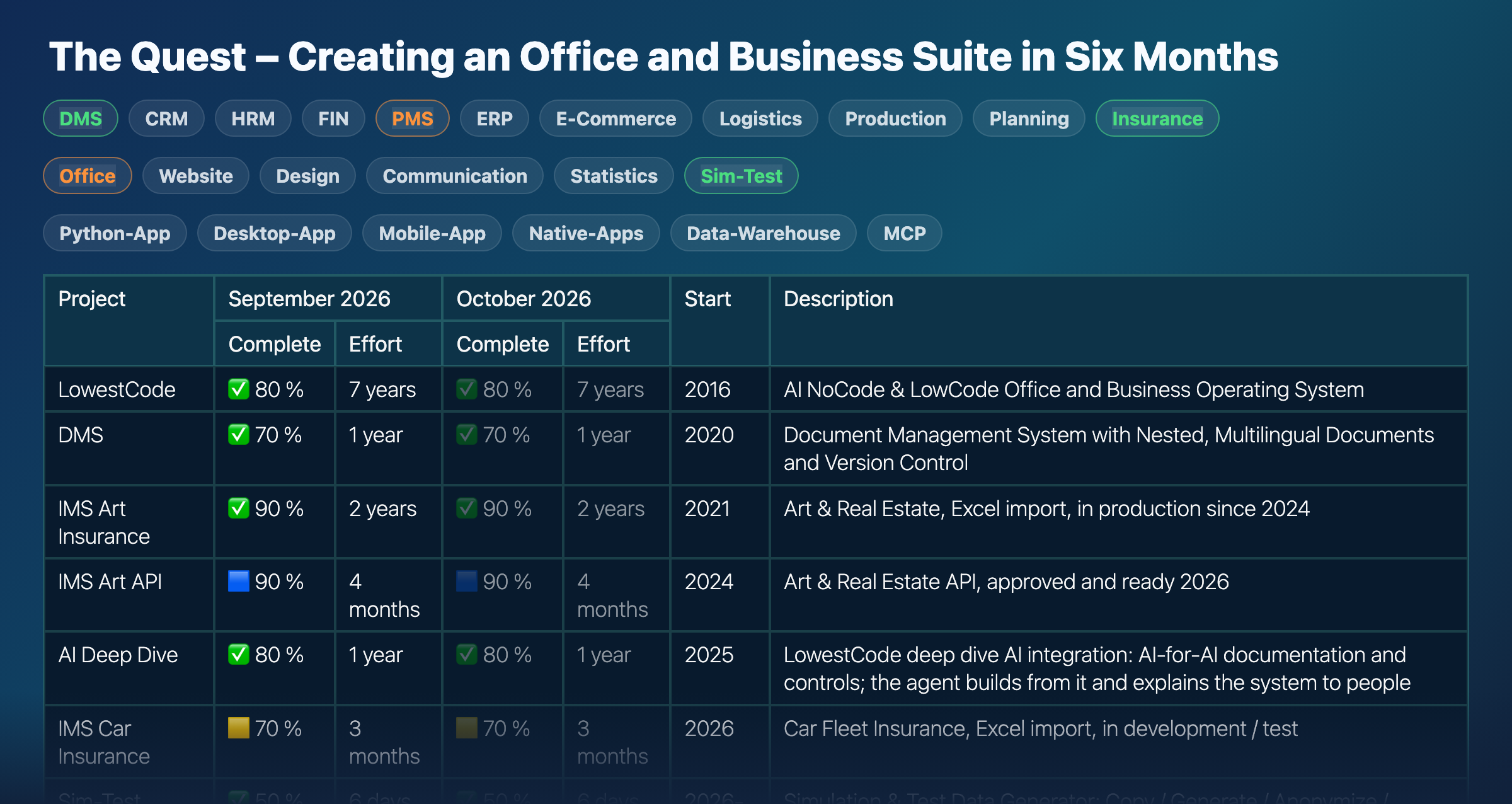 The Quest – updated every month
-
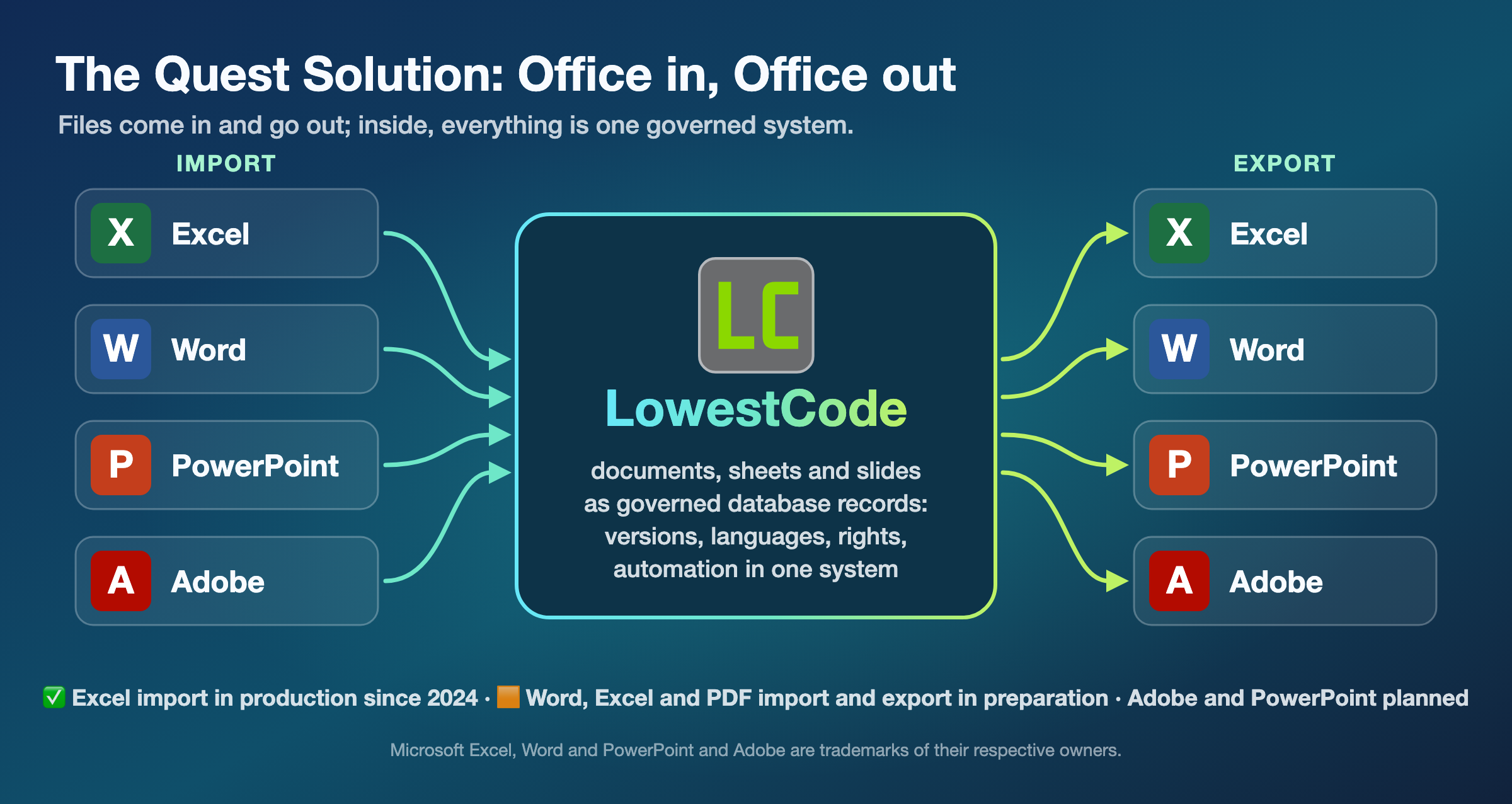 Import and export with Office tools
-
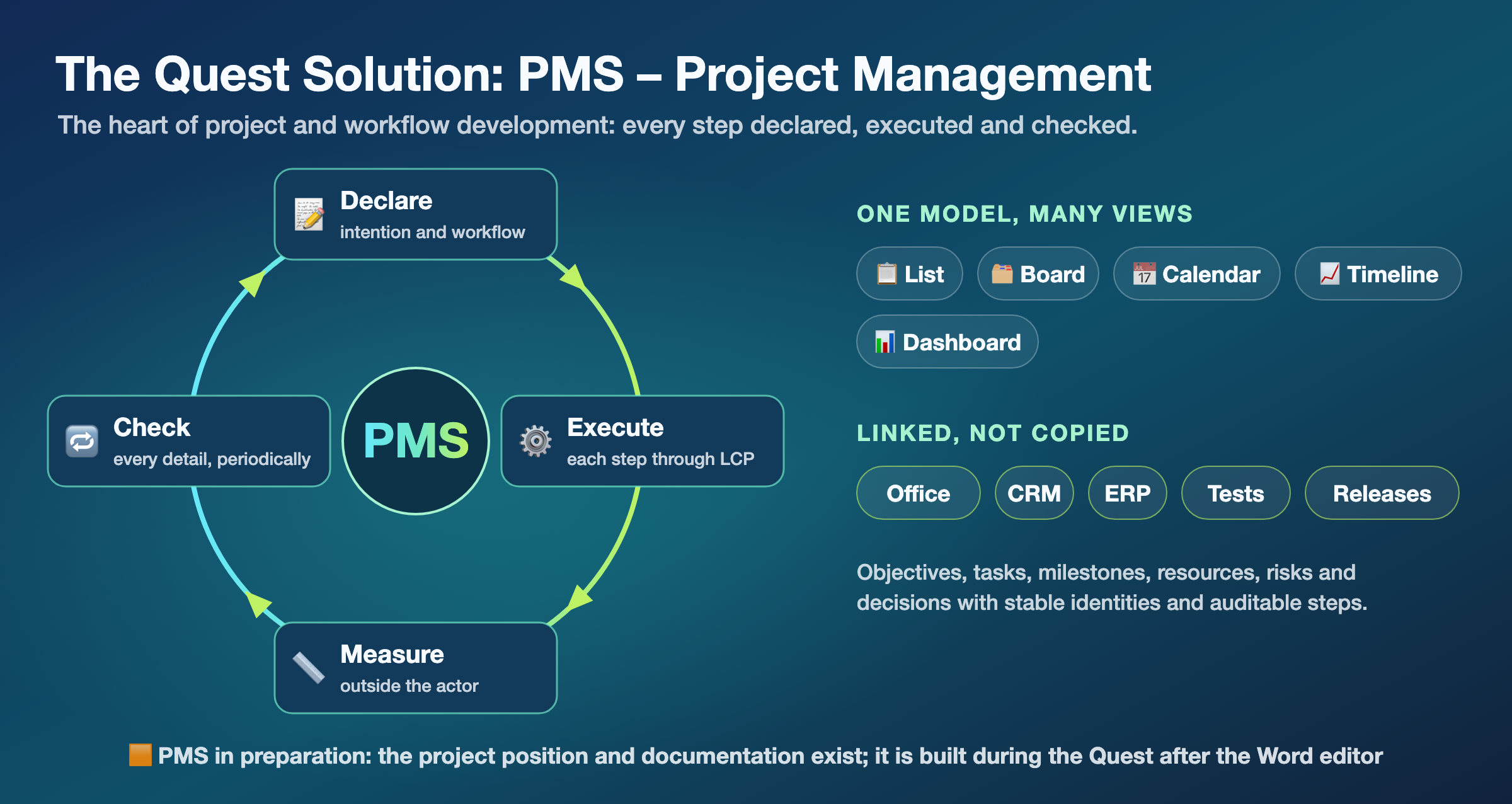 PMS: projects and workflows, declared and checked
-
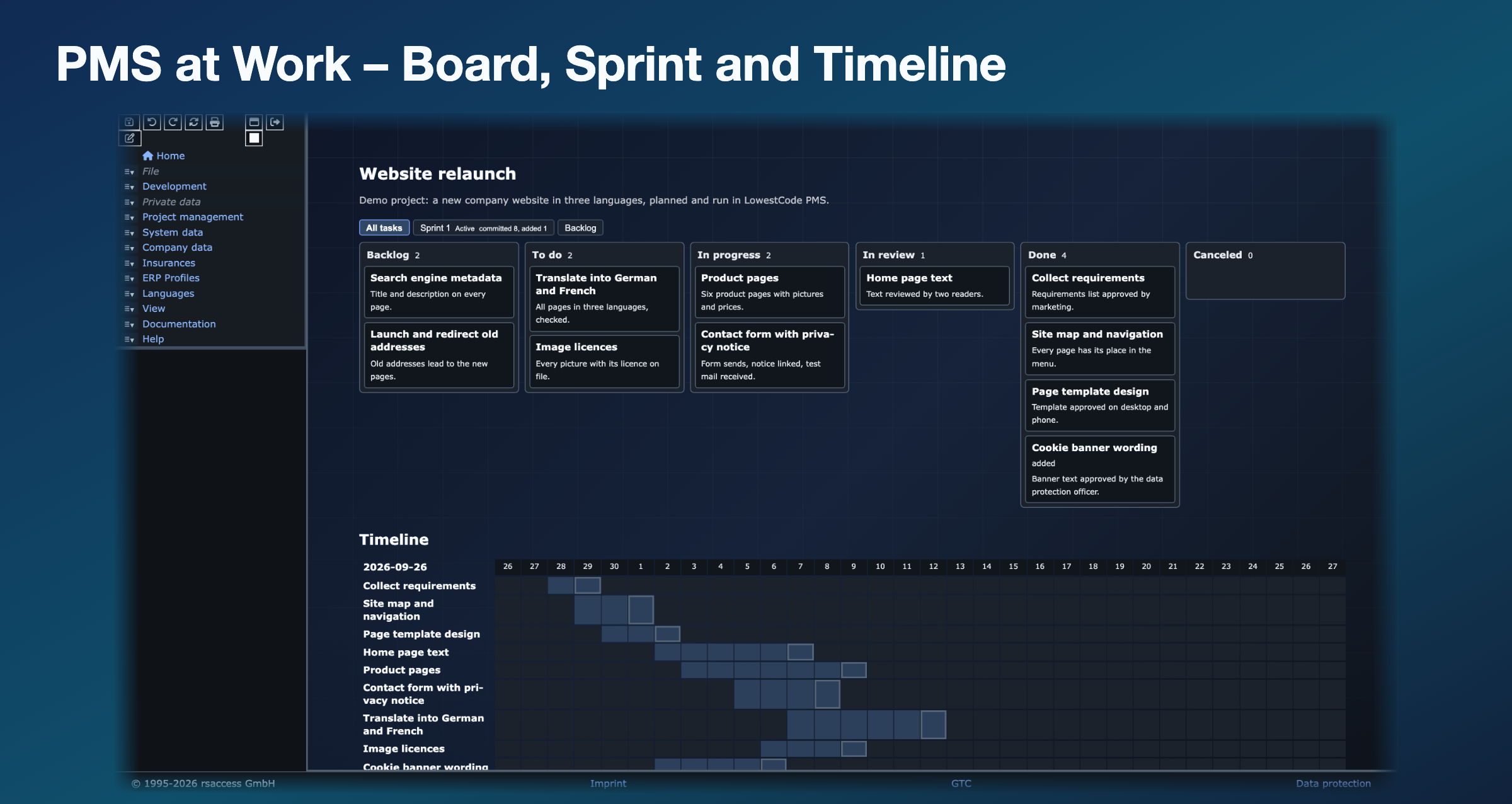 PMS at work: a demo project on the board, with its sprint and timeline
-
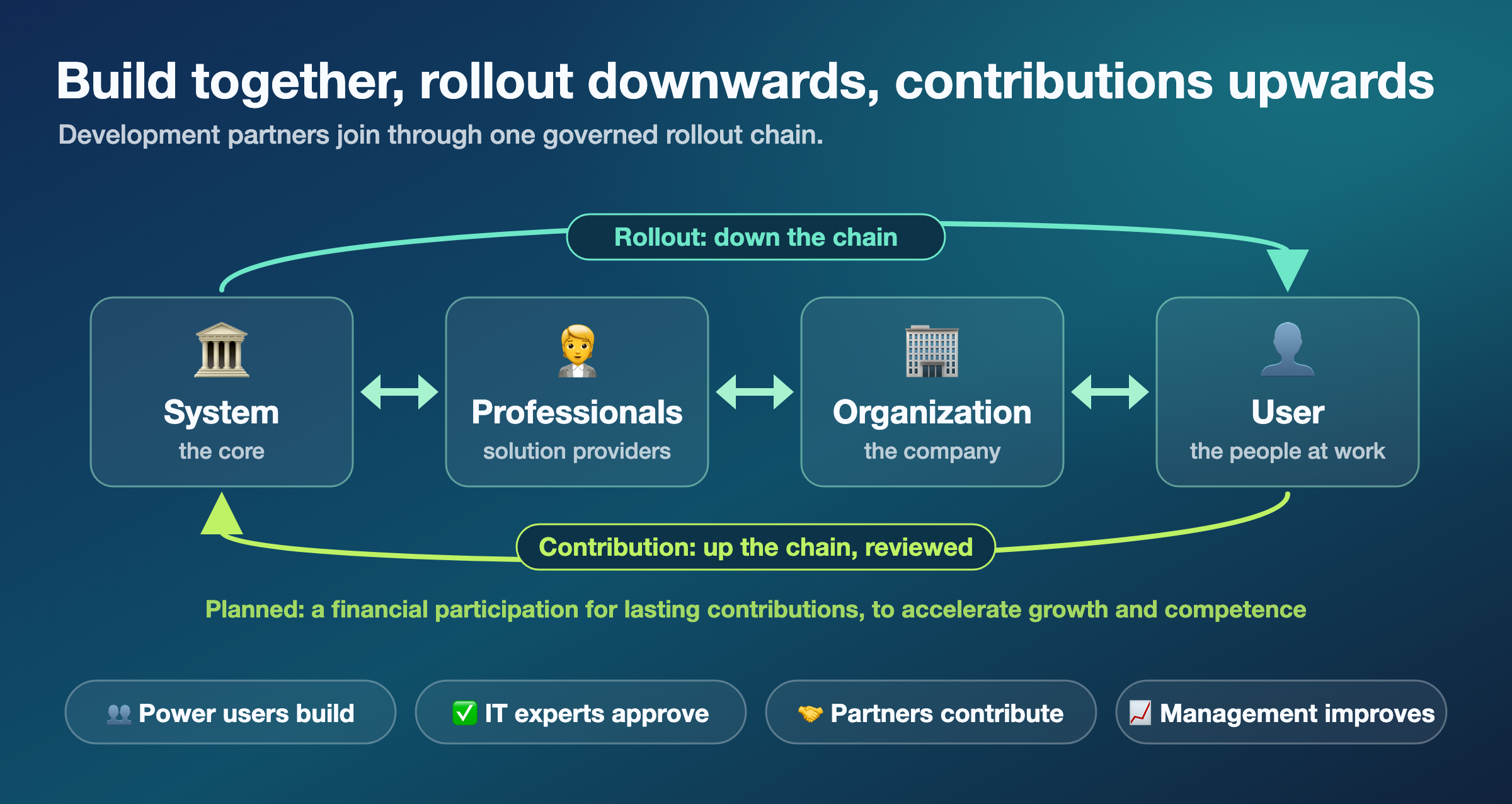 The rollout and contribution chain
-
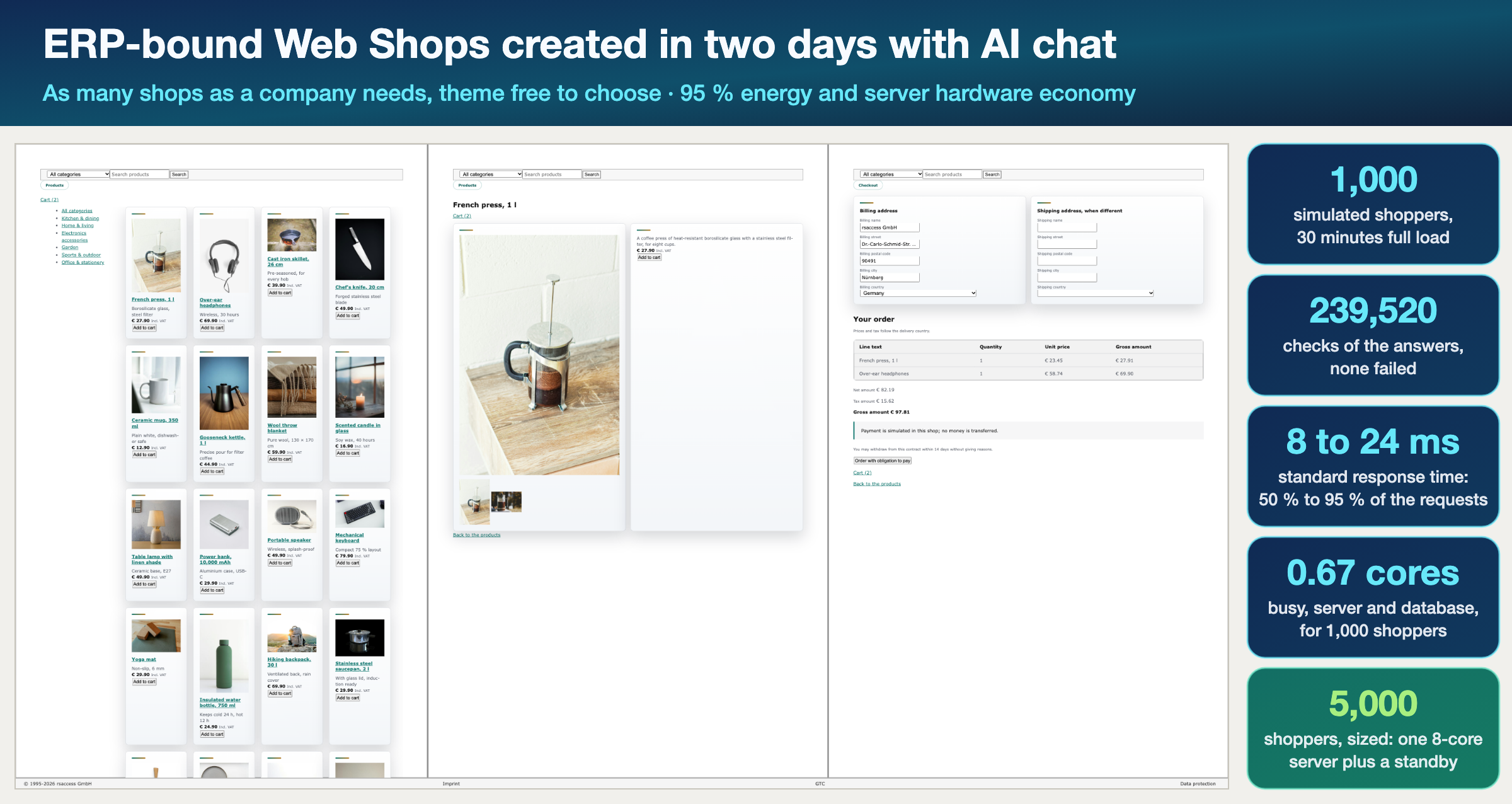 ERP-bound web shops, created in two days with AI chat and load-tested.
-
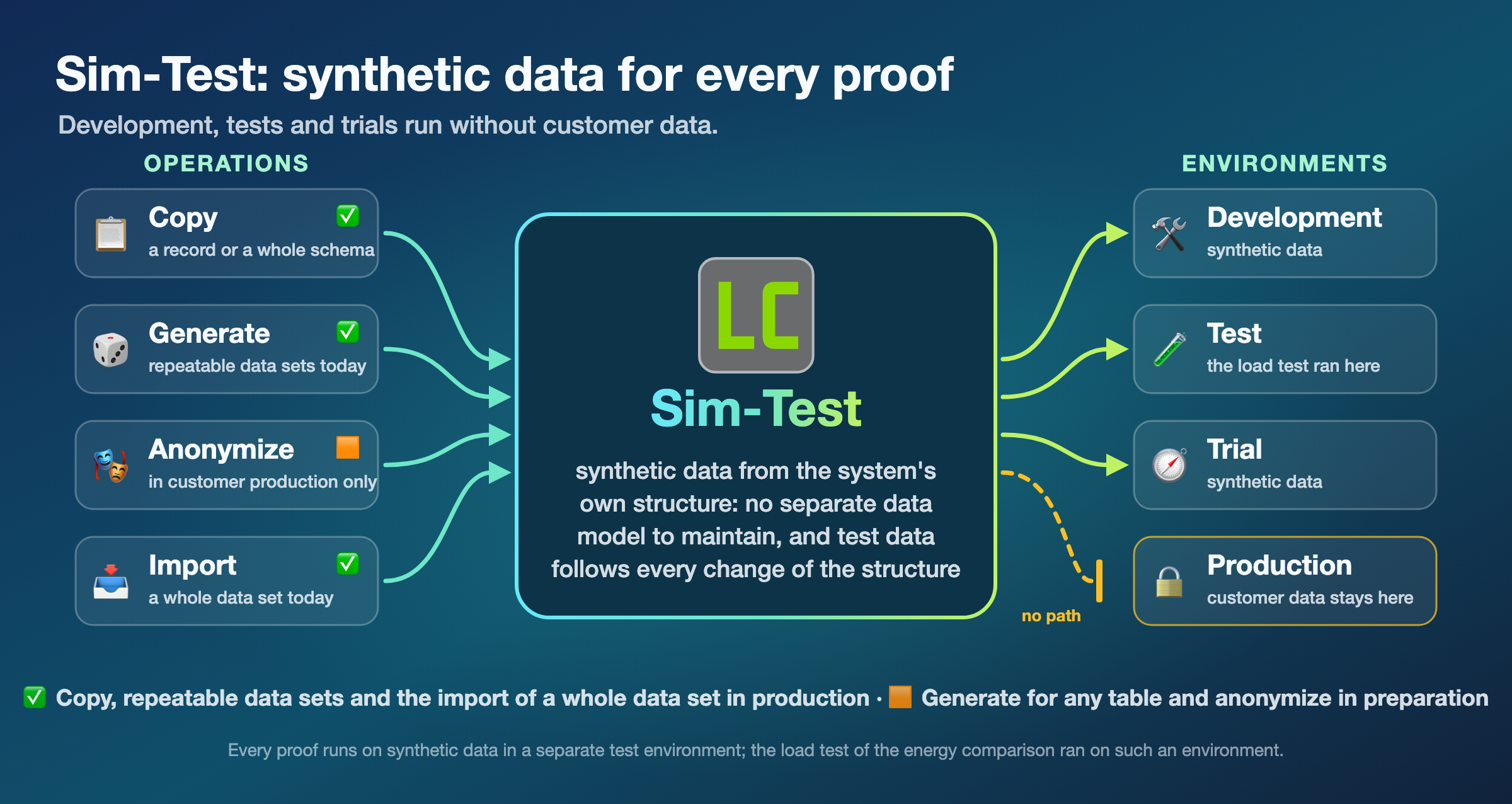 Sim-Test: synthetic data for development, test and trial
-
 Innovation and cooperation
LowestCode AI brings Office, ERP, e-commerce, and software development into one workspace. Individuals and businesses get work done and create or extend applications as needed through AI chat.
All LowestCode office and business applications are lightweight, clean, and fast—secure, privacy-focused, and multilingual by design, with 21 languages from the start. They run in European cloud environments or on desktops and are designed to support compliance with EU requirements for data protection, cybersecurity, and AI.
Our objective is a fully automatable system with a clear, well-structured architecture, enabling end-to-end automation of office work, business processes, and application development.
No more manual coding for professionals and users: coding, project management, and testing run entirely through AI chat under LowestCode’s controls, supported by a transparent architecture made for AI.
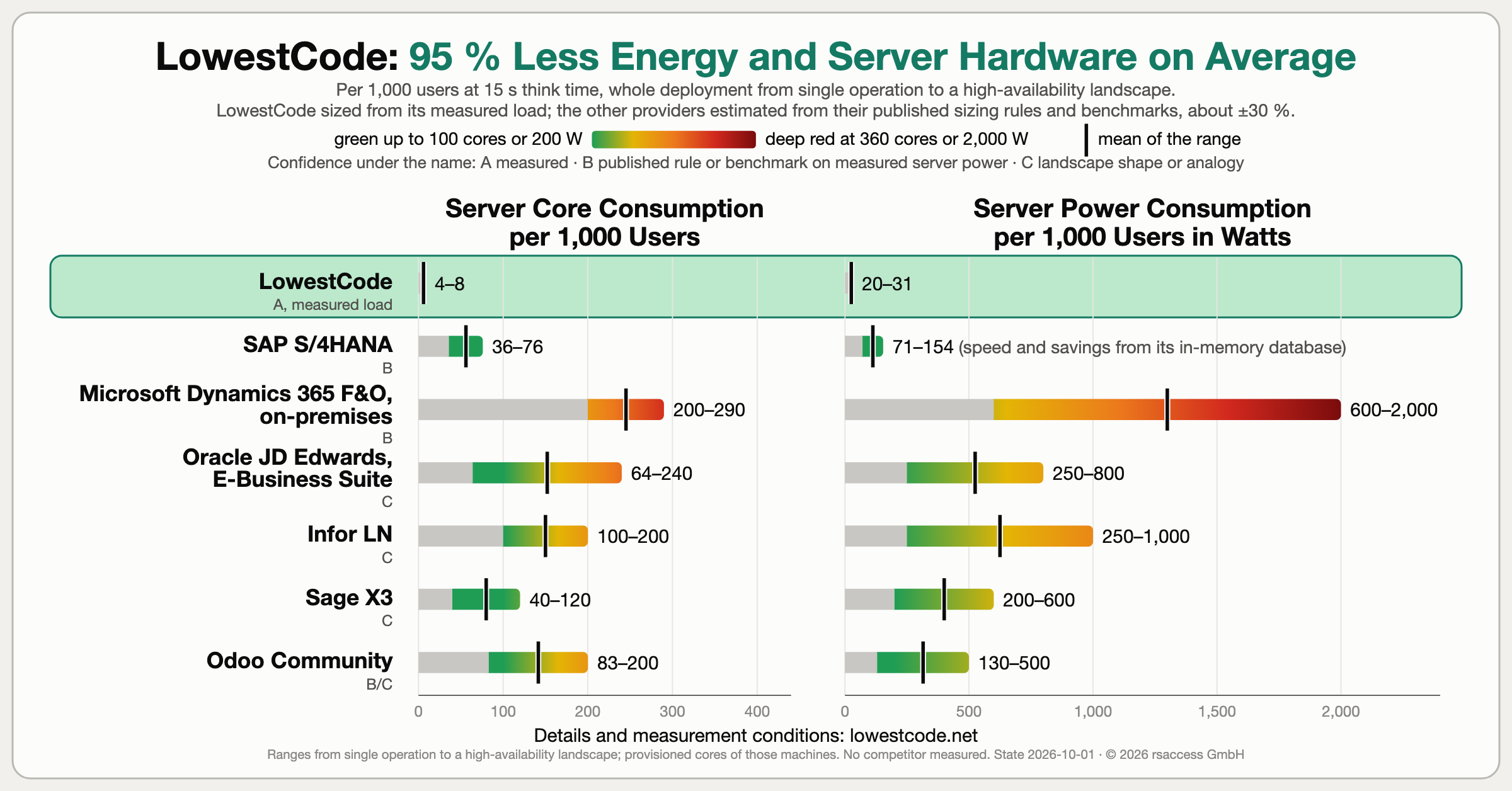
A green revolution for business software: on average, 95 % less energy use and server hardware than six leading business systems, based on our own load measurements and estimated sizing for those six systems.
Build together, roll out downwards, contribute upwards: system developers, IT service providers, customer organizations, and users develop independently without interfering with one another, supported by automated rollouts and controlled contributions.
LowestCode is designed to replace applications such as Microsoft Office, Microsoft Dynamics, SAP, Adobe, Salesforce, and Mendix, bringing office work, business operations, design, and application development into one integrated system.
Users adapt and optimize their workflows and applications by talking with the integrated AI agent, which respects the permissions for documents, forms, and users.
All product names are trademarks of their respective owners.
One system in place of many applications What LowestCode is designed to replace, and where each part stands today.
Companies run their work on many separate applications: an office package, an ERP, a CRM, design tools and a platform to build their own. LowestCode is designed to replace them with one system, and to go beyond them: built new, without the legacy of decades, with a modern workplace of several windows side by side, faster work in the cloud and professional options from the start. The map shows where each part stands today.
The whole range of LowestCode
- DMS
- CRM
- HRM
- FIN
- PMS
- ERP
- E-Commerce
- Logistics
- Production
- Planning
- Insurance
- Office
- Website
- Design
- Communication
- Statistics
- Sim-Test
- Gaming
- Learning
- Java-App
- Python-App
- Desktop-App
- Mobile-App
- Native-Apps
- Data-Warehouse
- LCP
- MCP adapter
The color of a pill shows the state of its project: in production, in test or in preparation; a pill without color is planned.
✅ In production · 🟨 In test · 🟧 In preparation · ⬜ Planned · As of
What it is designed to replace
The percentage is our estimate of how much of each project's planned scope is built, not a comparison with the named product.
Designed to replace | LowestCode part | State · planned scope built | Effort so far |
|---|---|---|---|
Microsoft Office Office work | Office-Text Office-Sheet Office-Table Office-Layout Office Design | ✅ 95 % ✅ 90 % 🟨 85 % ✅ 90 % ✅ 85 % | 28 days 12 days 2 days 4 days 4 days |
Adobe Design, graphics, PDF | Design, Draw, Paint and PDF tools | ✅ | – |
Microsoft Dynamics, SAP ERP | ERP FIN ERP Web Shop | 🟨 30 % 🟨 30 % ✅ 60 % | 2 days < 1 day 4 days |
Salesforce CRM | CRM | Planned | – |
Mendix Application building | LowestCode LCP-Chat LCP * MCP adapter * | ✅ 80 % ✅ 50 % ✅ 45 % 🟧 | 6 years 6 days 2 days – |
And more Projects, documents, test data | PMS DMS Sim-Test | ✅ 50 % ✅ 75 % ✅ 55 % | 4 days 1 year 6 days |
State and effort come from the project table of the Quest. Effort is the running time of the work, the time elapsed, rounded; 10 hours count as one day. A dash marks a part without a value of its own; the tools of Office are described under Office tool sets. * LCP is in production; the MCP adapter, the adapter for the external Model Context Protocol, is in preparation.
All product names are trademarks of their respective owners.
An application, not a suite
A suite bundles separate products, a word processor beside a spreadsheet, an ERP beside a CRM, each with its own data, rights and screens, joined by interfaces. LowestCode is one application: documents, sheets, business data, rights and versions live in one shared model, so a new part extends the application instead of adding a product to connect.
The Quest: public proof of the system and of high-speed development
October to December 2026: one AI agent, guided by one human, creates the Office and Business Application, and the state and the effort of every project are published month by month. The map and the pills take their values from it.
The AI agent codes. LowestCode controls. 100 % AI chat execution in one LowestCode system: coding, project management, and testing. Simultaneously, controlled and safe.
An automation engineer's approach, not an IT one: every operation is a defined step, checked before it acts and measured after it, as in a plant. Data, code and user interface form one model, every change runs with its rights decided first, and its result is measured outside the agent. That is why the agent can code, structure and test the whole system safely, and why every step of the system can be automated.

LowestCode is what AI needs: NoCode and LowCode in one integral, compact system for Office and business applications, and LCP controls every step. The result is controlled agent coding, high coding efficiency, and a clear interface for people.
95 % less energy and server hardware on average Documented resource efficiency: own load measurements and estimated sizing for six leading business systems; SAP comes closest with in-memory.
LowestCode keeps about one core busy for 1,000 users, measured; sized with headroom and a standby, that is four cores, eight with high availability on two sites. Five of the six other systems need far more, estimated from their published sizing rules, benchmarks and typical landscapes.
- 1.4 billionrows read by the database in one run
- 30 minutesof full load
- 171,000checks of the answers, none failed
- 9 to 136 msstandard response time: 50 % to 95 % of the requests
- ≈ 5 wattsprocessor power, load generator included
The web shops were measured the same way; their figures stand in the web shop picture and the load test report.
The numbers, their sources and the measurement are on these pages; no competitor product was measured. All product names are trademarks of their respective owners.
Power users deliver.
IT experts guide.
Development partners join through one governed rollout chain.
The LowestCode rollout system lets development partners build independently without interfering with one another, as the integrated AI agent does the coding and keeps it consistent.
- System
- Professionals
- Organization*
- User
We roll out code and data: documents and information such as taxes and legal information, where each customer can choose which services to implement.
Contributions travel up the chain in a controlled way. Once we are established on the market, we plan a participation system that rewards lasting contributions.
- User
- Organization*
- Professionals
- System
In addition, every partner installation rolls out from local development to production.
* In LowestCode development, the Organization level is played by the insurance use case, in practice since 2024.
LowestCode Office at work Text documents, tables, presentations, notes, reports and websites are forms of one governed document, not separate programs.
LowestCode Office is the working surface of the system, with the HTML editor and the form generator at its core: documents are written in the editor, forms are generated by the system rather than programmed, and both keep their rights, versions and languages in the system.
- Text
- Design & Publish
- Markdown
- Table
- Grid
- Sheet
- Project
- Figure
- Media
- Draw
- Paint
- Chart
- Layer
- Layout
- Version
- Binder
- Languages
- Properties
- Forms
- Secure Document AI Chat Agent
- Themes & Formats
Import and export: Word, Excel, PowerPoint and PDF are formats LowestCode Office imports and exports with its own means; the document itself, with its rights, versions and languages, stays in the system. All product names are trademarks of their respective owners.
Data protection and security by design
A LowestCode document is not a file on a disk or a share. It lives in the system, so the same rights, owners and versions decide who reads and changes it, people and the AI agent alike. A Word, Excel or PDF file is an export, not the document. Data protection and security come from how Office is built, not from a feature added afterwards.
One workplace.
One development IDE.
Many windows.
One shell for any application, LowestCode Office included.
Your windows, ready when you log in
From a single window to a complex working and development environment, the workplace fits the task. Your windows and their layout are saved and preloaded, ready the moment you log in. Working environments can be defined for each task and guarded by rights. Windows sit side by side, and the same document can be open in many of them, working in sync. The same system is your workplace and your development and test environment, so you build your own applications there and test them on synthetic data before they reach production. The test environment is independent of production, separate in data and files, and always available and accessible.
One menu, two views, one toolbar
The navigation is one menu shown two ways, as a side tree or as a top menu. The side menu doubles as the toolbar, with the HTML editor's controls in it, as on the left of the picture. Themes and formats change the look, not the content.
The development IDE inside the workplace
The development IDE is not a separate program. It uses the same multi-window workplace: the code walkthrough opens beside the forms and documents of the day, visible to developers by rights and invisible to everyone else. Users work in the normal workplace and never meet the coding capability.
An ERP for industry, from the order to the machine Trade, production, machine building and logistics in one system, built on a real industrial business.
We build the ERP on a real business: a metal profiling company that trades and sells online, profiles steel from the coil, sends profiles out for coating, builds machines for itself and for its customers, maintains them, takes on robot automation projects, and runs its own logistics and transport. The web shops are part of the ERP: their pages show the products, prices and taxes the back office maintains, as they stand at the moment of the view, and every order lands with its lines, addresses and payment where the back office works with it.
Sim-Test: synthetic data for every proof What a company gets from it: data checks, security, load checks and planning simulations.
Every company needs this, and most ignore it: software has to be proven before real data and real money depend on it, and proven without handing customers' data to developers, testers or an AI. Sim-Test makes both possible: synthetic data in the shape of your business, generated from your own structures.
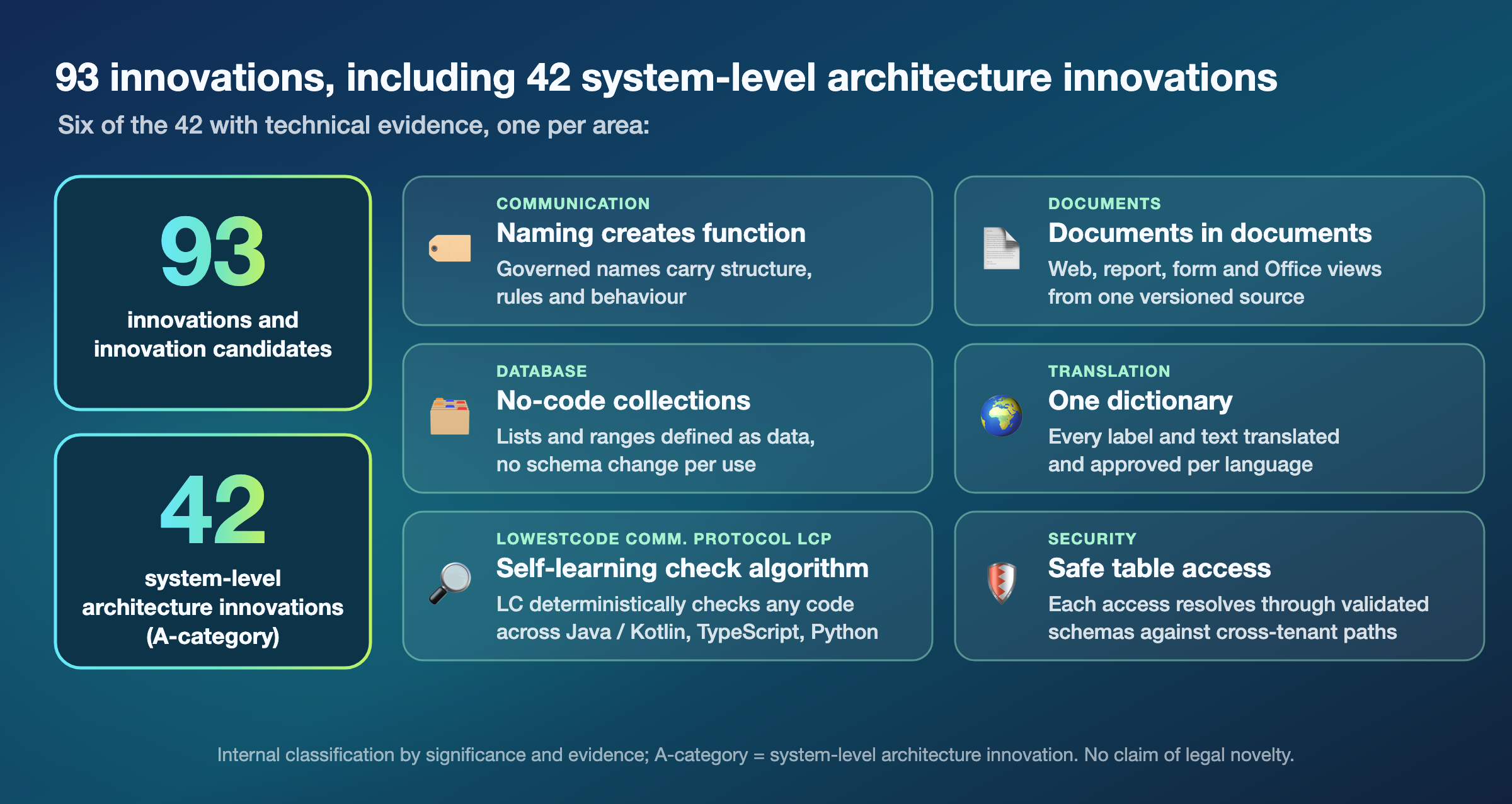
A structured innovation portfolio grounded in working software Deterministic AI, internationalization, digital sovereignty, and measurable efficiency.
We have structured a portfolio of 94 innovations and innovation candidates, including 43 system-level architecture innovations (A-category). They rethink how database semantics, documents and interfaces, automation, AI governance, security, and deployment work together. On this basis we are preparing a research grant application to the German research ministry (BMFTR, formerly BMBF) and are looking for a university partner.
For customers: What we modernize.
The business
Model: we deliver the technology, and partners bring it to customers. Revenue comes from licenses per user and month, through partners and direct, and from building applications for customers with the AI agent.
First market: mid-sized companies, insurers and organizations in the German-speaking countries that modernize Office work, processes, Excel and VBA. We enter through concrete projects.
Market: Office and ERP are the core markets; Gartner forecasts USD 58.2 billion for low-code technologies worldwide in 2029 (forecast analysis of November 2025).
Expansion: partners offer LowestCode as their own application layer; AI providers and cloud hosts add it to their models and hosting.
Investment: we are looking for strategic investors who are partners as well, and for business angels. The funds go mainly into marketing and sales, then into partner engineering and operations, toward one goal: LowestCode in common use, nationally and across Europe.
LowestCode in short One integral, compact system for Office and business applications, and LCP controls every step. Many problems solved.
In use and measured today
- ✅Ten years of development, proven in real use: insurance software certified and in production since 2024 at an international insurance group, with due diligence passed and labor union approval.
- 🧠We don't write code anymore: since September 2026, coding, project management and testing run 100 % by AI chat, on the NoCode & LowCode (NCLC) system with the LowestCode Communication Protocol (LCP), which checks each request before it runs.
- ⚡About one busy core for 1,000 users, measured: in one 44-minute load run, 30 minutes of it at full load, the database reads more than 1.4 billion rows, and the device does not even get warm.
- ⚡Green tech: 95 % less energy and server hardware on average than six leading business systems, from our own load measurements and estimated sizing for the six; SAP comes closest with in-memory.
- 🌍21 application languages from the start, and each partner can add languages or define dialect variants; right-to-left scripts, time zones and country formats are built in.
- 🆓No license fees for components: every third-party component is free open source. AI agents and cloud hosting are external services with their own terms.
How it works
- 📄Office, business applications and ERP in one workspace: LowestCode Office stands built since 8 November 2026 and is in our own use, and the ERP with its web shops is being built in the same system.
- 🏅One rollout and contribution chain: System ⬌ Professionals ⬌ Organization ⬌ User. Partners build independently, and contributions travel back up in a controlled way.
- ⚙️An automation engineer's approach toward a fully automatable system: every operation is a defined step, checked before it acts and measured after it, as in a plant, and people, workflows and the AI agent run the same steps.
- 🔒Data protection and security by design: every document and record keeps its rights, owners and versions in the system, for people and the AI agent alike; development and test run on synthetic data. Designed for the EU rules: GDPR and EU cybersecurity for the cloud, the EU AI Act for the AI.
We set the direction. AI agents code. LCP controls.
© 1995-2026 Dr.-Ing. Raimund Reisacher –
LowestCode technology
German patent application DE 10 2021 103 571 –
relational database system, pending
© 1995-2026 rsaccess GmbH –
LowestCode website, marketing and sales
LowestCodeLowestCode © Dr.-Ing. Raimund Reisacher · hosted by rsaccess GmbH
This document is available in English only. It is the text we check and verify.
Energy and Server Comparison
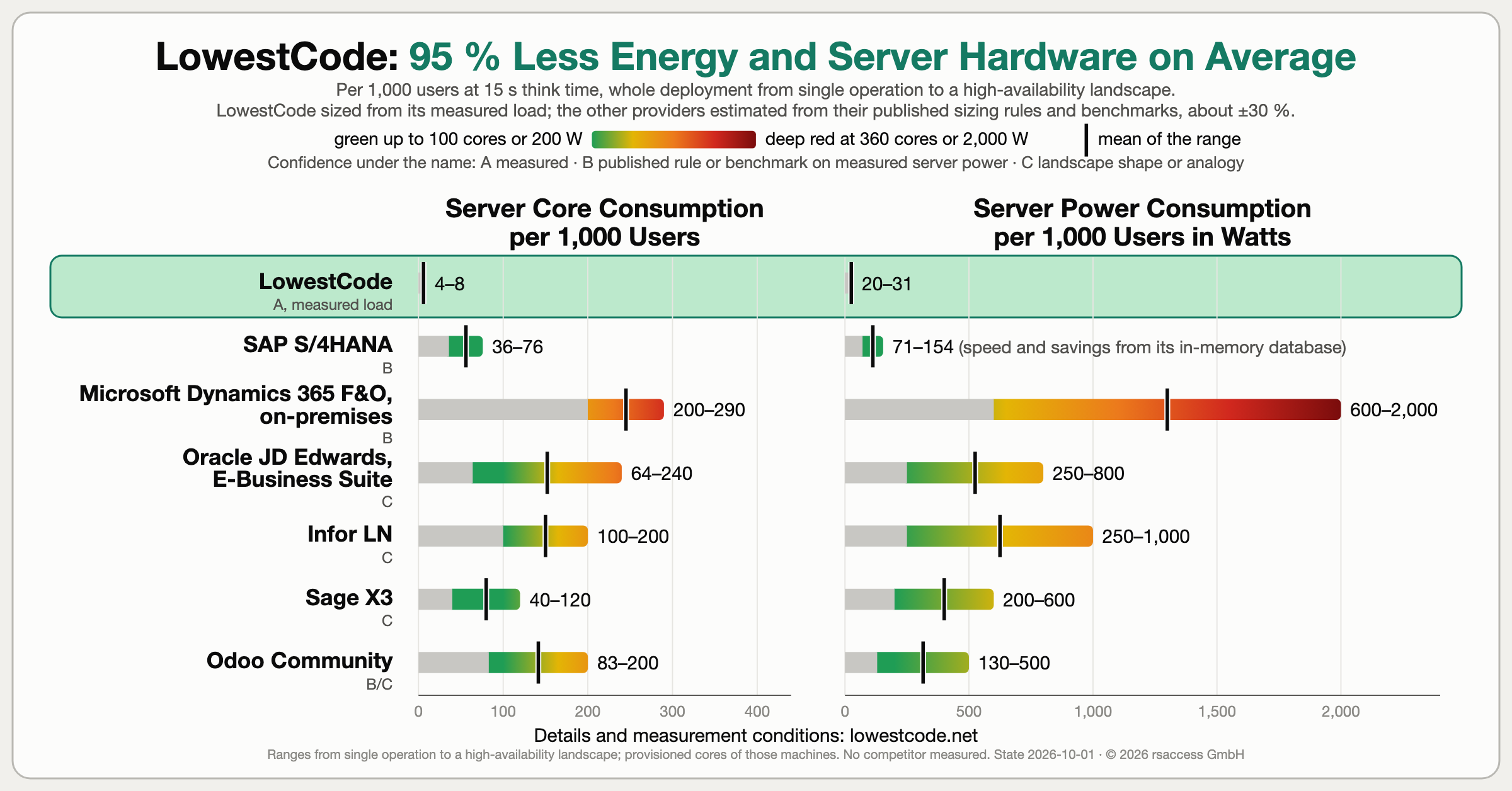
This page compares the server hardware and the power that LowestCode and six leading business systems need for 1,000 users. It shows the numbers, says where each one comes from, and says what the comparison proves and what it does not. State: 3 October 2026.
The result in short
- LowestCode needs 80 to 99 % less energy and server hardware than five of the six systems, about 90 % in the middle of that range.
- Against SAP S/4HANA it needs about 80 % fewer server cores and 51 to 67 % less power. SAP's work per user is small; its hardware comes from the database held in memory and the replicated host that guards it.
- Against the mean values of the six: 95 % less power and 95 % fewer server cores.
- The LowestCode side is measured and then sized for real operation. The other side is estimated: from the providers' own published sizing rules and certified benchmarks and, where a provider publishes none for the whole installation, from the shape of a typical landscape. No competitor product was measured.
The numbers
Server cores and power per 1,000 users. Each row is a range: from the smallest setup a product runs on, to a landscape with high availability.
|
Provider
|
Server cores
|
Power
|
Basis
|
|---|---|---|---|
|
LowestCode
|
4–8
|
20–31 W
|
A
|
|
SAP S/4HANA
|
20–44
|
41–94 W
|
B
|
|
Microsoft Dynamics 365 F&O, on-premises
|
200–290
|
600–2,000 W
|
B
|
|
Oracle JD Edwards, E-Business Suite
|
64–240
|
250–800 W
|
C
|
|
Infor LN
|
100–200
|
250–1,000 W
|
C
|
|
Sage X3
|
40–120
|
200–600 W
|
C
|
|
Odoo Community
|
83–200
|
130–500 W
|
B/C
|
- A is measured.
- B is a published sizing rule or certified benchmark of the provider, put on measured server power.
- C is the shape of a typical landscape of that product, or an analogy.
The estimates of the six providers are accurate to about ±30 %. Every row is scaled to 1,000 users; where a row rests on the provider's own published sizing rules, these include headroom.
One load run you can picture
1,000 simulated office users, 44 minutes, one device: 3 minutes idle, 10 minutes ramp-up, 30 minutes under full load, then the ramp-down. In that time the users perform about 141,000 actions; each of the 171,000 answers is checked for its content, and none fails. To serve them, the database reads more than 1.4 billion rows. The processor draws about 5 watts for the whole test, the load generator included. The device does not even get warm.
The full record of the five runs is the load test report.
Where each number comes from
LowestCode. We measured the load: 1,000 users keep 1.2 processor cores busy, server and database together. A real installation needs more than the busy cores, so we sized it. For single operation the machines run at about 40 % load and one standby machine waits: 4 cores and 20 watts per 1,000 users. For high availability the same setup stands on two sites, and either site can carry the full load alone: 8 cores and 31 watts. The measurement is described in the load test report.
The arithmetic, done at 10,000 users: the 12.1 busy cores run on four servers with 8 cores each, at about 40 % load, and a fifth server waits as standby, 40 cores in all. By its published power data, a Dell PowerEdge T150 draws about 21 watts idle and 84 watts at full load. At 40 % load each active server draws about 45 watts and the standby about 21 watts, together about 201 watts: 4 cores and 20 watts per 1,000 users. On two sites, ten such servers, eight of them sharing the load and two waiting, come to 80 cores and about 307 watts: 8 cores and 31 watts per 1,000 users.
SAP S/4HANA. We sized SAP the way SAP sizes an installation, with its own published rules. SAP's Quick Sizer counts users by activity: a medium user works one step every 30 seconds, a high user one every 10 seconds; our users work one every 15 seconds. SAP sizes the processors for an average load of one third. For 1,000 users that gives an application server of 4 to 6 cores. The database of S/4HANA, SAP HANA, holds its data in memory and runs in production only on servers SAP certifies. In the published lists of AWS, Google Cloud and Microsoft Azure the smallest of them by cores has 8 cores and 248 GB of memory, on Google Cloud; for availability a second server of the same size keeps a replicated copy. That memory has its own price: server memory has become very expensive, and its supply is uncertain, so a database held in memory costs more than its watts show. That makes about 20 to 22 cores and 41 to 47 watts for single operation, on the published power curve of the Lenovo SR650 V3, the server of SAP's own certified benchmark; with high availability on two sites 40 to 44 cores and 82 to 94 watts. Two caveats: the processor share per user follows SAP's classic factors, and S/4HANA's own factors are not published and probably higher; the database server is the smallest certified size by cores, while a real database of 1,000 users may need more memory. Both make SAP's row a lower estimate. SAP's certified benchmark itself, 65,208 users on one 120-core server, ran SAP ERP 6.0 on IBM Db2, not S/4HANA: it shows how efficient SAP's order-processing core is in a best case, not how large an installation is.
Microsoft Dynamics 365 Finance and Operations, on-premises. Microsoft publishes a sizing rule in users per core and a minimum topology with spare nodes and a paired database server. Applied to 1,000 users this gives 200 to 290 cores.
Oracle JD Edwards and E-Business Suite. We found no per-user rule, so the range follows the shape of a typical landscape: database and application hosts, from a single machine to high availability. This is the least certain kind of estimate.
Infor LN. Infor's minimum hardware guide names 10 cores for 100 concurrent users. Scaled to 1,000 users that is 100 cores, and 200 with high availability.
Sage X3. Sage publishes a sizing rule for its web tier. The application, database and print hosts of a usual installation come on top.
Odoo Community. Odoo publishes how many concurrent users one processor serves. The database comes on top, from a single machine to a pair.
The power figures put these cores on servers with published, measured power data.
What the numbers say, and what they do not
They say that LowestCode needs far fewer and far smaller machines than five of the six systems: against their documented ranges it is 80 to 99 % less energy and server hardware. Against SAP S/4HANA the difference is smaller, about 80 % fewer server cores and 51 to 67 % less power: SAP comes closest with in-memory, because its hardware is set by the database held in memory rather than by the work of its users. Against the mean values of the six, LowestCode needs 95 % less power and 95 % fewer server cores. Against Microsoft Dynamics 365 Finance and Operations on-premises it needs about 98 % less power and 98 % fewer server cores at the mean values, up to 99 % at the high-availability end.
|
Provider
|
Mean cores
|
Times LowestCode
|
Mean power
|
Times LowestCode
|
|---|---|---|---|---|
|
LowestCode
|
6
|
25.5 W
|
||
|
SAP S/4HANA
|
32
|
5×
|
67.5 W
|
2.6×
|
|
Microsoft Dynamics 365 F&O, on-premises
|
245
|
41×
|
1,300 W
|
51×
|
|
Oracle JD Edwards, E-Business Suite
|
152
|
25×
|
525 W
|
21×
|
|
Infor LN
|
150
|
25×
|
625 W
|
25×
|
|
Sage X3
|
80
|
13×
|
400 W
|
16×
|
|
Odoo Community
|
141.5
|
24×
|
315 W
|
12×
|
|
Mean of the six
|
137
|
23×
|
546 W
|
21×
|
They do not say that anyone measured a competitor. The six rows are estimates from the providers' own documents. No other system was measured on this workload.
Where the difference comes from. The work itself is small. SAP's certified benchmark, a best case on one tuned standard process of SAP ERP 6.0, needs between one and two busy cores for 1,000 of its benchmark users, the same class as our measured 1.2 cores. The work of 1,000 office users is a few watts for a well-built system. The energy goes into the machines a product needs in order to run at all: its separate tiers, its minimum sizes, its spare capacity, and for SAP the database held in memory. LowestCode runs as one small application with its database, and that is where the saving is.
Calculated first, then measured. The result is no surprise. Months before the load tests we compared LowestCode with a conventional stack layer by layer: application, database, cache, search, document storage, queue and monitoring servers. That calculation gave 80 to 96 % less energy and server hardware, about 90 % in the middle. The measured load, sized for operation, gives 95 % against the mean of the six documented systems: the upper end of what we calculated.
What is included. The savings come from one model, not from leaving things out. The measured system carries what a business system needs: rights checked on the server, traceable changes, versions, multilingual texts, time zones, and tenants and environments kept apart.
Sources
- SAP sizing (sap.com/about/benchmark/sizing.html), Quick Sizer user classes and SAPS definition
- SAP Standard Application Benchmark, SD definition and certification Cert23002 (Lenovo Press lp1685)
- SAP HANA certified instances: AWS (docs.aws.amazon.com/sap/latest/general/sap-hana-aws-ec2.html), Google Cloud (docs.cloud.google.com/sap/docs/certifications-sap-hana), Microsoft Azure (learn.microsoft.com/en-us/azure/sap/workloads/hana-vm-premium-ssd-v1)
- SPECpower_ssj2008 results 20230619-01282, 20240328-01390 and 20230829-01308
- Apple support article 103253
- Microsoft Learn, hardware sizing requirements for on-premises environments
- Odoo 18.0 deployment documentation
- Infor LN 10.3 minimum hardware requirements
- Sage X3 Syracuse sizing recommendations
All product names are trademarks of their respective owners.