
+¦a1¦+
  •  Home
  • Documentation
    • Companies
      • What we modernize
      • Platform
      • Technology overview
      • Technical data
    • Partners and investors
      • Innovation and cooperation
    • Projects
      • Overview
      • DMS
      • PMS
        • Overview
      • ERP
      • Insurance
      • Office
        • Overview
      • Sim-Test
    • Energy, economy & security
      • Provider comparison
      • Load test report
      • Security
      • Economy
    • The Quest
      • Overview
      • September 2026
    • About
  •  Contact
  •  Login
+¦a3¦+
+¦a4¦+
+¦b1¦+
+¦b2¦+
+¦b3¦+
+¦b4¦+
  •  Home
  • Documentation
    • Companies
      • What we modernize
      • Platform
      • Technology overview
      • Technical data
    • Partners and investors
      • Innovation and cooperation
    • Projects
      • Overview
      • DMS
      • PMS
        • Overview
      • ERP
      • Insurance
      • Office
        • Overview
      • Sim-Test
    • Energy, economy & security
      • Provider comparison
      • Load test report
      • Security
      • Economy
    • The Quest
      • Overview
      • September 2026
    • About
  •  Contact
  •  Login
+¦ls1-s01¦+
+¦ls1-s02¦+
+¦ls1-s03¦+
+¦ls1-s04¦+
+¦ls2-s01¦+
+¦ls2-s02¦+
+¦ls2-s03¦+
+¦ls2-s04¦+
+¦ls3-s01¦+
+¦ls3-s02¦+
+¦ls3-s03¦+
+¦ls3-s04¦+
+¦ls4-s01¦+
+¦ls4-s02¦+
+¦ls4-s03¦+
+¦ls4-s04¦+
+¦r1c1-s01-code¦+
+¦r1c1-s01-toc¦+
+¦r1c1-s01-doc¦+
+¦r1c1-s02-code¦+
+¦r1c1-s02-toc¦+
+¦r1c1-s02-doc¦+
+¦r1c1-s03-code¦+
+¦r1c1-s03-toc¦+
+¦r1c1-s03-doc¦+
+¦r1c1-s04-code¦+
+¦r1c1-s04-toc¦+
+¦r1c1-s04-doc¦+
+¦r1c1-s05-code¦+
+¦r1c1-s05-toc¦+
+¦r1c1-s05-doc¦+
+¦r1c1-s06-code¦+
+¦r1c1-s06-toc¦+
+¦r1c1-s06-doc¦+
+¦r1c1-s07-code¦+
+¦r1c1-s07-toc¦+
+¦r1c1-s07-doc¦+
+¦r1c1-s08-code¦+
+¦r1c1-s08-toc¦+
+¦r1c1-s08-doc¦+
+¦r1c1-s09-code¦+
+¦r1c1-s09-toc¦+
+¦r1c1-s09-doc¦+
+¦r1c1-s10-code¦+
+¦r1c1-s10-toc¦+
+¦r1c1-s10-doc¦+
+¦r1c1-s11-code¦+
+¦r1c1-s11-toc¦+
+¦r1c1-s11-doc¦+
+¦r1c1-s12-code¦+
+¦r1c1-s12-toc¦+
+¦r1c1-s12-doc¦+
+¦r1c1-s13-code¦+
+¦r1c1-s13-toc¦+
+¦r1c1-s13-doc¦+
+¦r1c1-s14-code¦+
+¦r1c1-s14-toc¦+
+¦r1c1-s14-doc¦+
+¦r1c1-s15-code¦+
+¦r1c1-s15-toc¦+
+¦r1c1-s15-doc¦+
+¦r1c1-s16-code¦+
+¦r1c1-s16-toc¦+
+¦r1c1-s16-doc¦+
+¦r1c2-s01-code¦+
+¦r1c2-s01-toc¦+
+¦r1c2-s01-doc¦+
+¦r1c2-s02-code¦+
+¦r1c2-s02-toc¦+
+¦r1c2-s02-doc¦+
+¦r1c2-s03-code¦+
+¦r1c2-s03-toc¦+
+¦r1c2-s03-doc¦+
+¦r1c2-s04-code¦+
+¦r1c2-s04-toc¦+
+¦r1c2-s04-doc¦+
+¦r1c2-s05-code¦+
+¦r1c2-s05-toc¦+
+¦r1c2-s05-doc¦+
+¦r1c2-s06-code¦+
+¦r1c2-s06-toc¦+
+¦r1c2-s06-doc¦+
+¦r1c2-s07-code¦+
+¦r1c2-s07-toc¦+
+¦r1c2-s07-doc¦+
+¦r1c2-s08-code¦+
+¦r1c2-s08-toc¦+
+¦r1c2-s08-doc¦+
+¦r1c2-s09-code¦+
+¦r1c2-s09-toc¦+
+¦r1c2-s09-doc¦+
+¦r1c2-s10-code¦+
+¦r1c2-s10-toc¦+
+¦r1c2-s10-doc¦+
+¦r1c2-s11-code¦+
+¦r1c2-s11-toc¦+
+¦r1c2-s11-doc¦+
+¦r1c2-s12-code¦+
+¦r1c2-s12-toc¦+
+¦r1c2-s12-doc¦+
+¦r1c2-s13-code¦+
+¦r1c2-s13-toc¦+
+¦r1c2-s13-doc¦+
+¦r1c2-s14-code¦+
+¦r1c2-s14-toc¦+
+¦r1c2-s14-doc¦+
+¦r1c2-s15-code¦+
+¦r1c2-s15-toc¦+
+¦r1c2-s15-doc¦+
+¦r1c2-s16-code¦+
+¦r1c2-s16-toc¦+
+¦r1c2-s16-doc¦+
+¦r1c3-s01-code¦+
+¦r1c3-s01-toc¦+
+¦r1c3-s01-doc¦+
+¦r1c3-s02-code¦+
+¦r1c3-s02-toc¦+
+¦r1c3-s02-doc¦+
+¦r1c3-s03-code¦+
+¦r1c3-s03-toc¦+
+¦r1c3-s03-doc¦+
+¦r1c3-s04-code¦+
+¦r1c3-s04-toc¦+
+¦r1c3-s04-doc¦+
+¦r1c3-s05-code¦+
+¦r1c3-s05-toc¦+
+¦r1c3-s05-doc¦+
+¦r1c3-s06-code¦+
+¦r1c3-s06-toc¦+
+¦r1c3-s06-doc¦+
+¦r1c3-s07-code¦+
+¦r1c3-s07-toc¦+
+¦r1c3-s07-doc¦+
+¦r1c3-s08-code¦+
+¦r1c3-s08-toc¦+
+¦r1c3-s08-doc¦+
+¦r1c3-s09-code¦+
+¦r1c3-s09-toc¦+
+¦r1c3-s09-doc¦+
+¦r1c3-s10-code¦+
+¦r1c3-s10-toc¦+
+¦r1c3-s10-doc¦+
+¦r1c3-s11-code¦+
+¦r1c3-s11-toc¦+
+¦r1c3-s11-doc¦+
+¦r1c3-s12-code¦+
+¦r1c3-s12-toc¦+
+¦r1c3-s12-doc¦+
+¦r1c3-s13-code¦+
+¦r1c3-s13-toc¦+
+¦r1c3-s13-doc¦+
+¦r1c3-s14-code¦+
+¦r1c3-s14-toc¦+
+¦r1c3-s14-doc¦+
+¦r1c3-s15-code¦+
+¦r1c3-s15-toc¦+
+¦r1c3-s15-doc¦+
+¦r1c3-s16-code¦+
+¦r1c3-s16-toc¦+
+¦r1c3-s16-doc¦+
+¦r1c4-s01-code¦+
+¦r1c4-s01-toc¦+
+¦r1c4-s01-doc¦+
+¦r1c4-s02-code¦+
+¦r1c4-s02-toc¦+
+¦r1c4-s02-doc¦+
+¦r1c4-s03-code¦+
+¦r1c4-s03-toc¦+
+¦r1c4-s03-doc¦+
+¦r1c4-s04-code¦+
+¦r1c4-s04-toc¦+
+¦r1c4-s04-doc¦+
+¦r1c4-s05-code¦+
+¦r1c4-s05-toc¦+
+¦r1c4-s05-doc¦+
+¦r1c4-s06-code¦+
+¦r1c4-s06-toc¦+
+¦r1c4-s06-doc¦+
+¦r1c4-s07-code¦+
+¦r1c4-s07-toc¦+
+¦r1c4-s07-doc¦+
+¦r1c4-s08-code¦+
+¦r1c4-s08-toc¦+
+¦r1c4-s08-doc¦+
+¦r1c4-s09-code¦+
+¦r1c4-s09-toc¦+
+¦r1c4-s09-doc¦+
+¦r1c4-s10-code¦+
+¦r1c4-s10-toc¦+
+¦r1c4-s10-doc¦+
+¦r1c4-s11-code¦+
+¦r1c4-s11-toc¦+
+¦r1c4-s11-doc¦+
+¦r1c4-s12-code¦+
+¦r1c4-s12-toc¦+
+¦r1c4-s12-doc¦+
+¦r1c4-s13-code¦+
+¦r1c4-s13-toc¦+
+¦r1c4-s13-doc¦+
+¦r1c4-s14-code¦+
+¦r1c4-s14-toc¦+
+¦r1c4-s14-doc¦+
+¦r1c4-s15-code¦+
+¦r1c4-s15-toc¦+
+¦r1c4-s15-doc¦+
+¦r1c4-s16-code¦+
+¦r1c4-s16-toc¦+
+¦r1c4-s16-doc¦+
+¦r2c1-s01-code¦+
+¦r2c1-s01-toc¦+
LowestCode AI • Governed AI Development • Digital Sovereignty

LowestCode Green AI Office and Business Application

by RSaccess

One AI system, designed to replace
Microsoft Office, Microsoft Dynamics, Adobe, SAP and more.

One AI Workspace for Office & Business
With AI App Development Built In

In production since 2024 at an international insurance group: certified, due-diligence approved, and backed by the labor union. In the Quest, October to December 2026, one AI agent guided by one human creates an Office and Business App, with monthly, public, verifiable proof.

Contact Our range Investors and partners
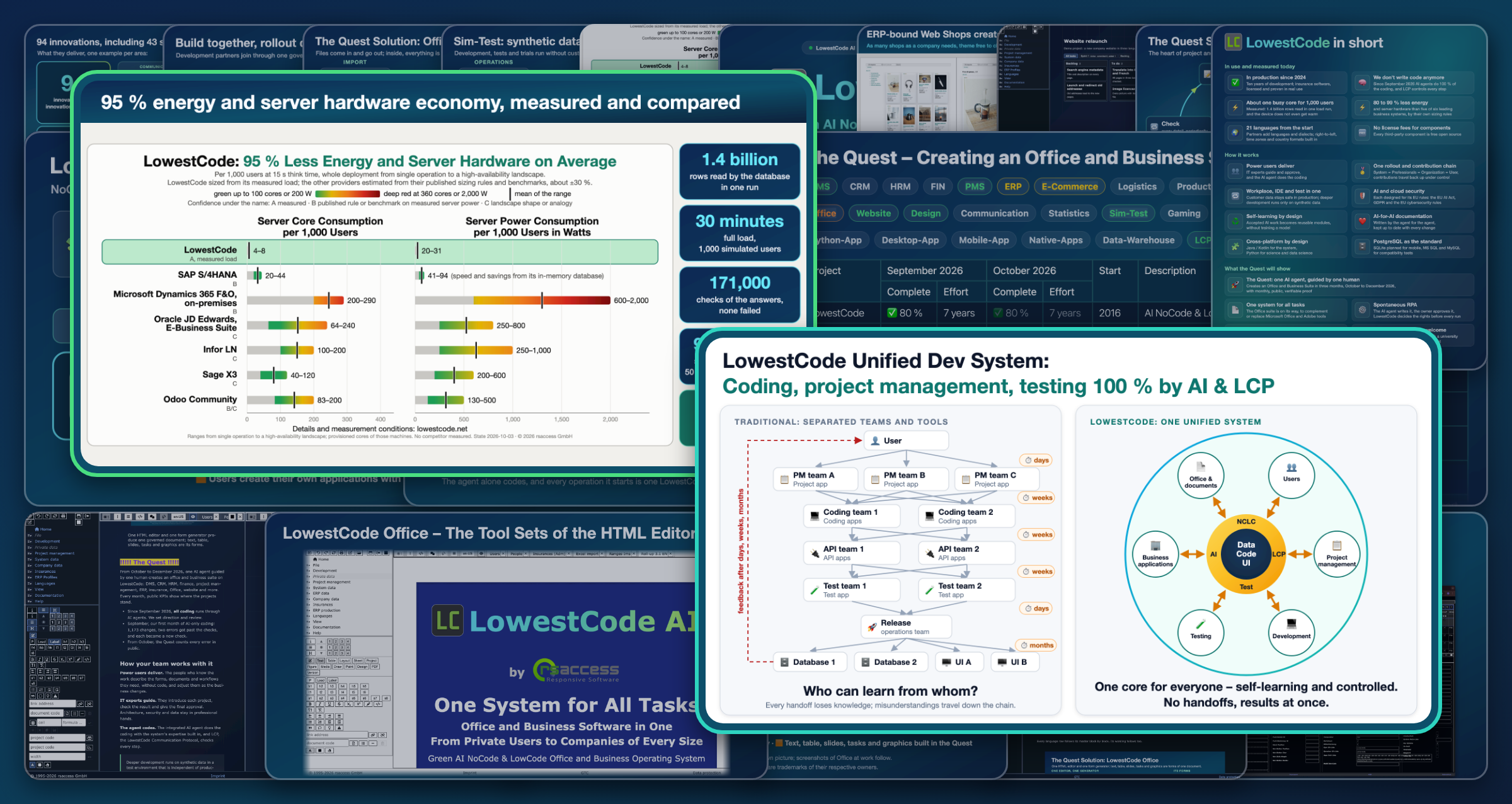
  • LowestCode at a glance: twenty pictures of LowestCode. In the background, behind a light veil, eighteen pictures as a crowd showing the variety: the small cards of the innovations, the rollout and contribution chain, Office in and out, Sim-Test, the load test, the share card, the web shop, the PMS demo board and PMS across the top, the platform, IDE coding integration and the Quest large in the middle, the card LowestCode in short at the top right, and across the bottom a screenshot of Office-Text with one document in three windows, the Office tool sets of the HTML editor on a roll-up design, the LowestCode Office figure, a screenshot of Office-Sheet and the multi-window workplace. In front, the focus: top left the energy picture, 95 % energy and server hardware economy, measured and compared, framed in green, and bottom right on top of everything the Unified Dev System picture, coding, project management, testing 100 % by AI and LCP, framed in teal LowestCode at a glance: twenty pictures in one
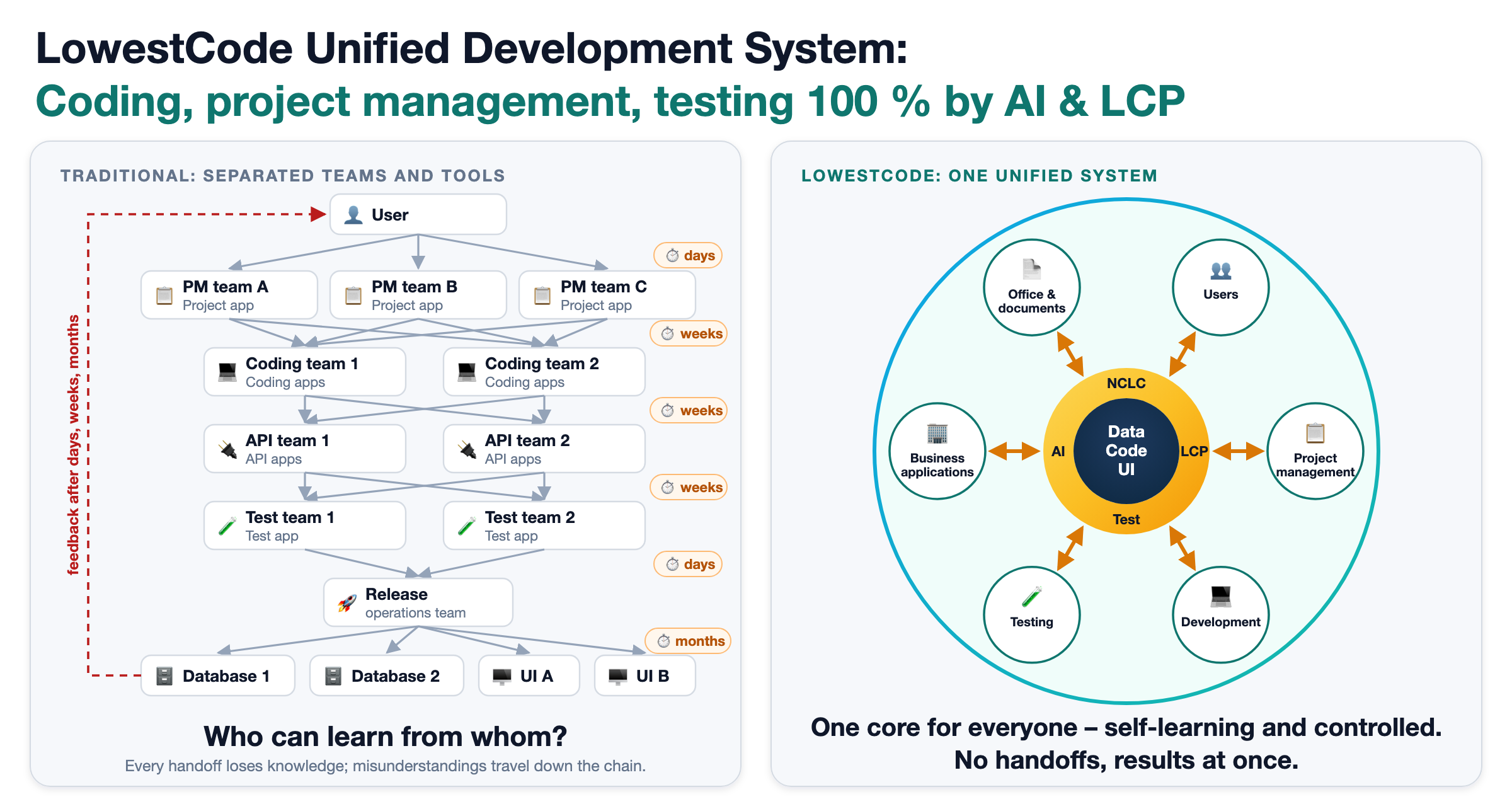
  • LowestCode Unified Development System: coding, project management, testing 100 % by AI and LCP. On the left traditional development, the user passing a need through project management, coding, API and test teams, each with its own apps, to separate databases and screens, the feedback after days, weeks or months, and the question who can learn from whom; on the right LowestCode, users, project management, development, testing, business applications and Office around one circle, connected through the band of AI, NCLC, LCP and Test to one core of data, code and UI: one core for everyone, self-learning and controlled, no handoffs, results at once LowestCode Unified Development System:
    Coding, project management, testing 100 % by AI & LCP
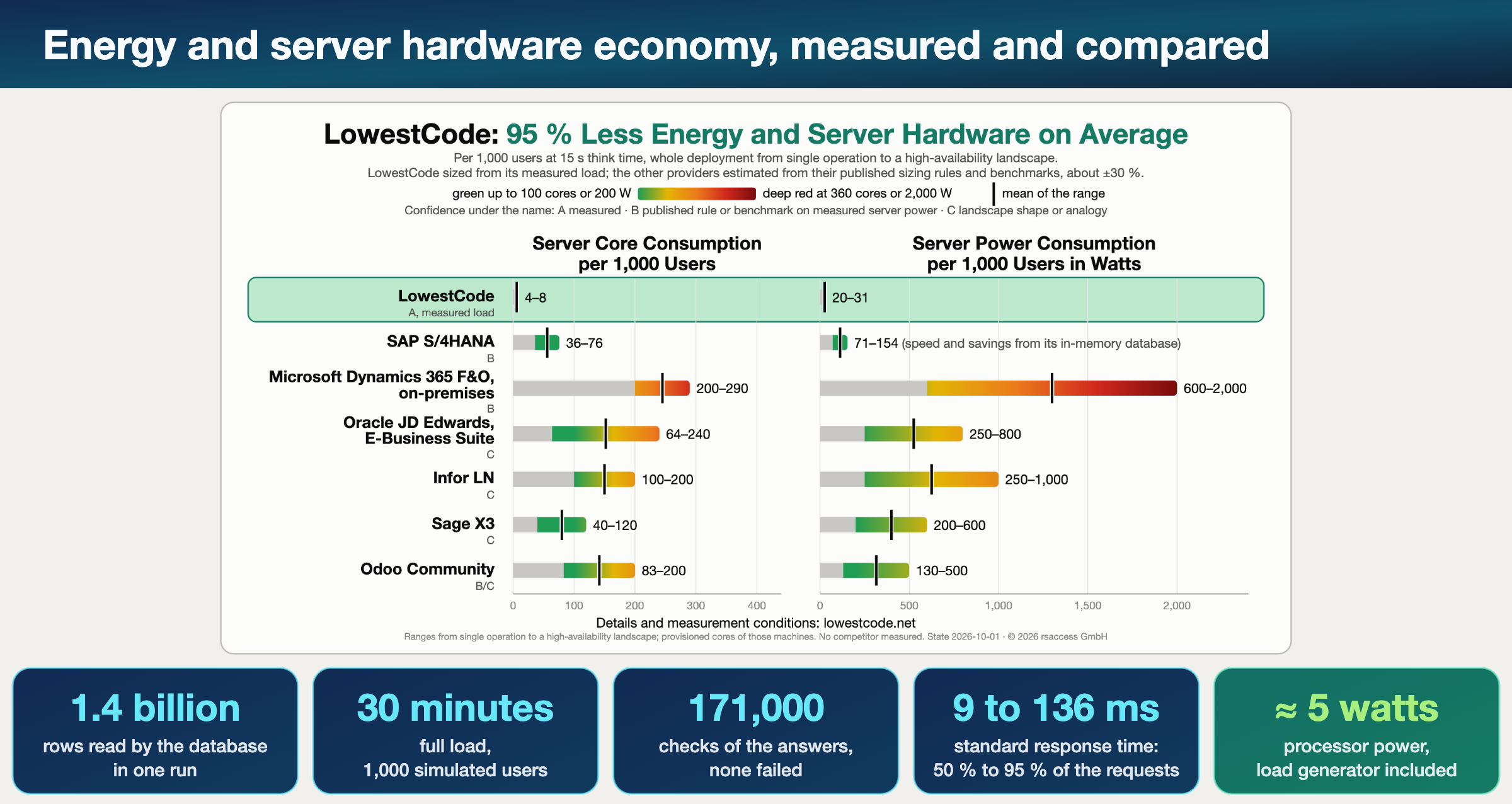
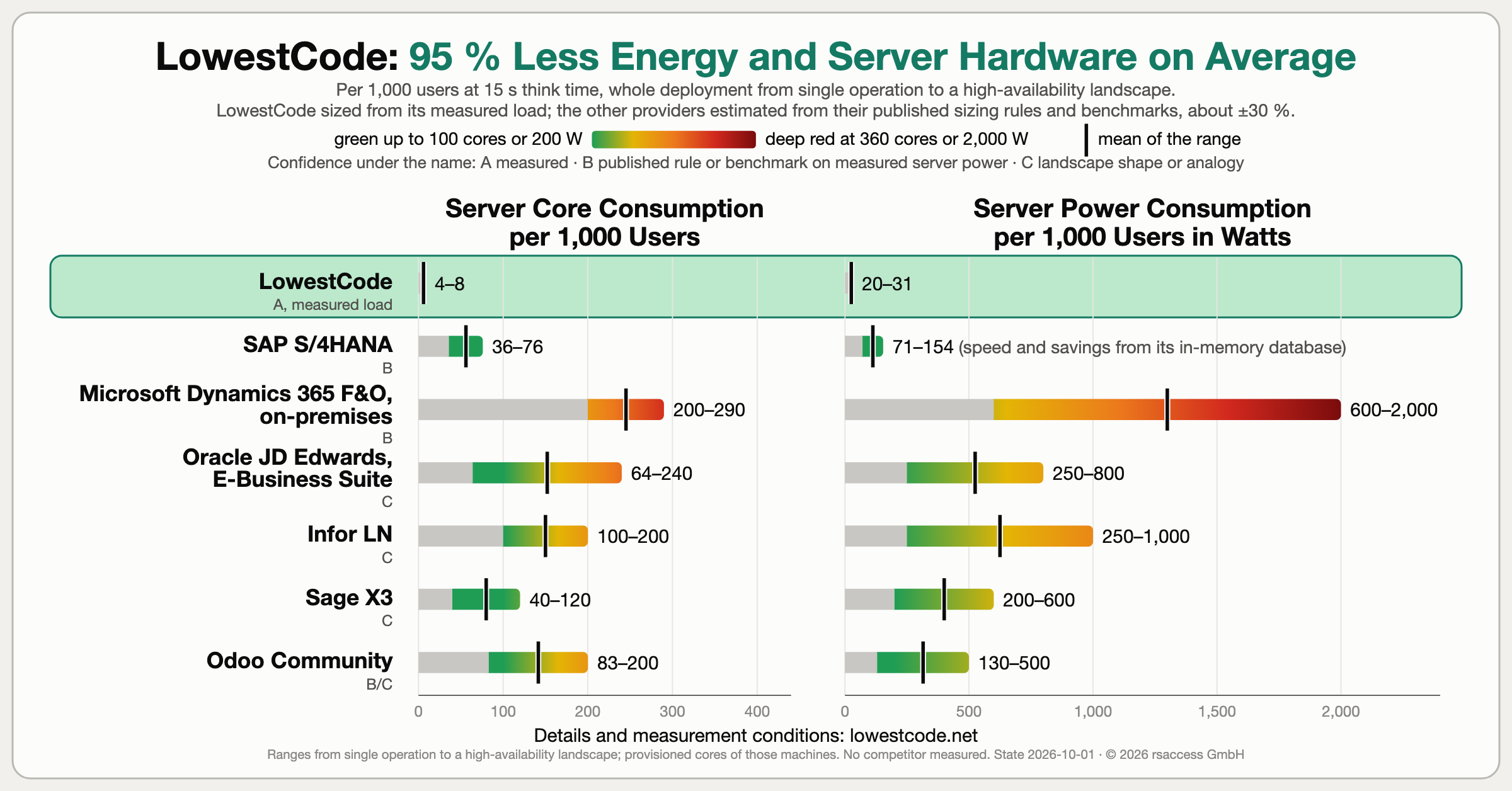
  • 95 % energy and server hardware economy, measured and compared: the LowestCode power and server hardware comparison, server cores and watts per 1,000 users for LowestCode and six providers, each a range from single operation to a high-availability landscape, LowestCode sized from its measured load, with the mean of each range marked; beside it the load test: 1.4 billion rows read by the database in one run, 30 minutes of full load with 1,000 simulated users, 171,000 checks of the answers with none failed, 9 to 136 ms standard response time for 50 % to 95 % of the requests, and about 5 watts processor power, load generator included Energy and server hardware per 1,000 users
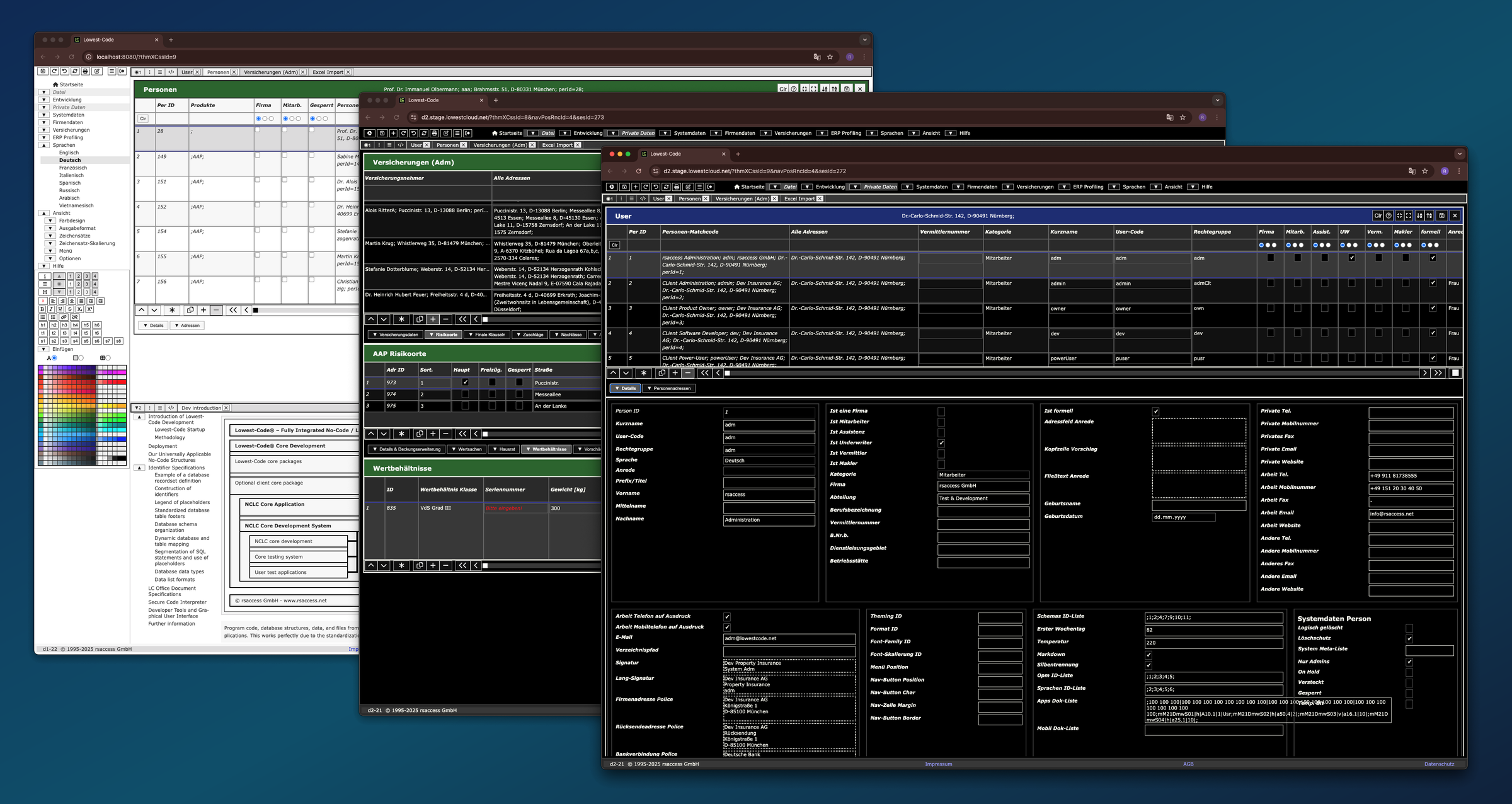
  • Multi-Window Workplace – Choose Your Theme: three workplace windows in three themes: the people table with the side navigation tree, the insurance administration with its child lists for risk locations and valuables under the top menu, and the user form with its field groups The workplace: several windows of one system side by side, in three themes
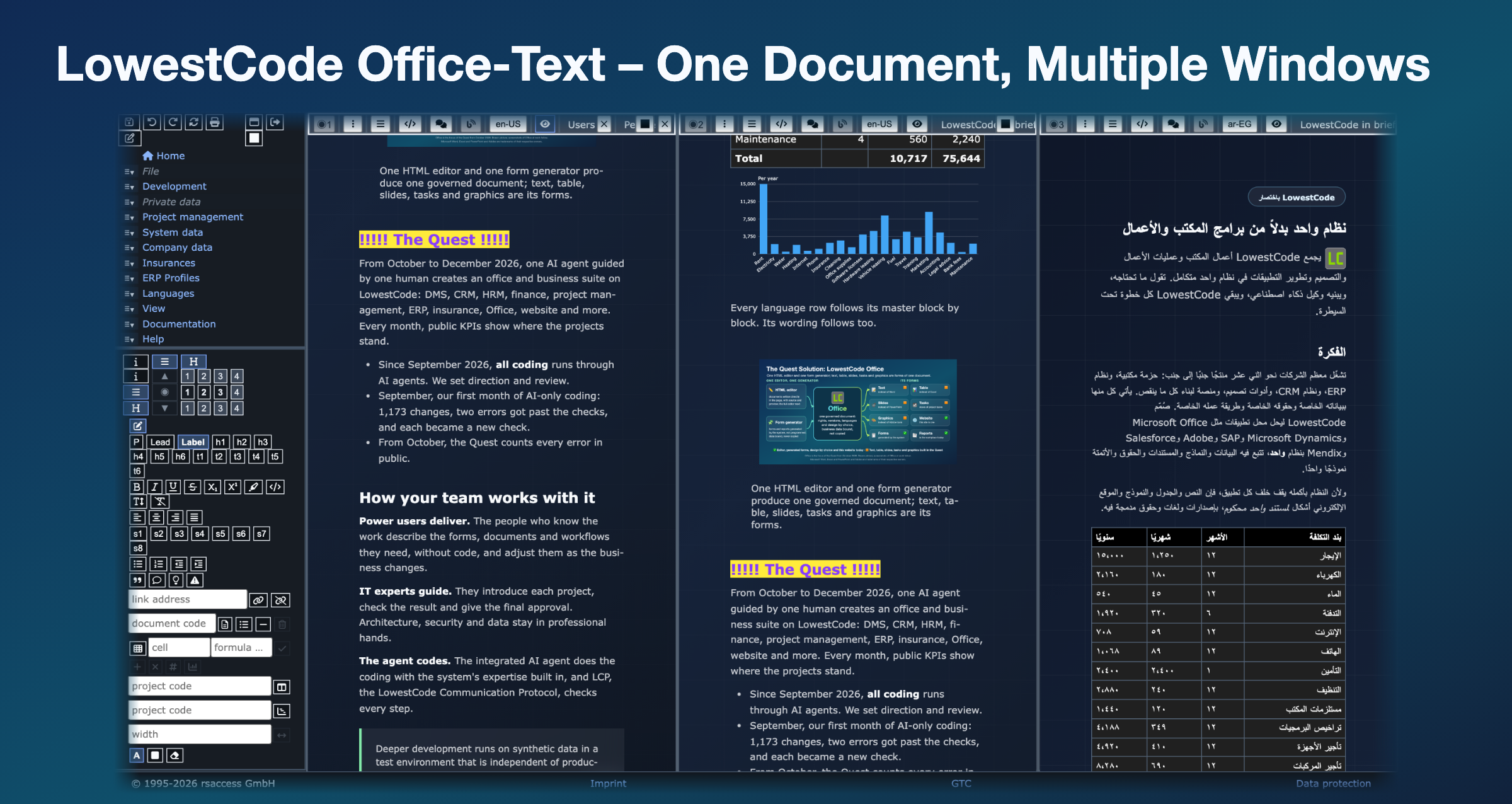
  • LowestCode Office-Text – One Document, Multiple Windows. Screenshot of the LowestCode workplace: on the left the side menu with the HTML editor's toolbar below it; to its right three windows side by side, the document LowestCode in brief open in the editor in the first and shown in the second, each scrolled to its own place with the yellow-marked heading The Quest at a different height, and its Arabic translation, right to left, from its start in the third LowestCode Office-Text at work: one document in three windows, each scrolled on its own, built for full RPA
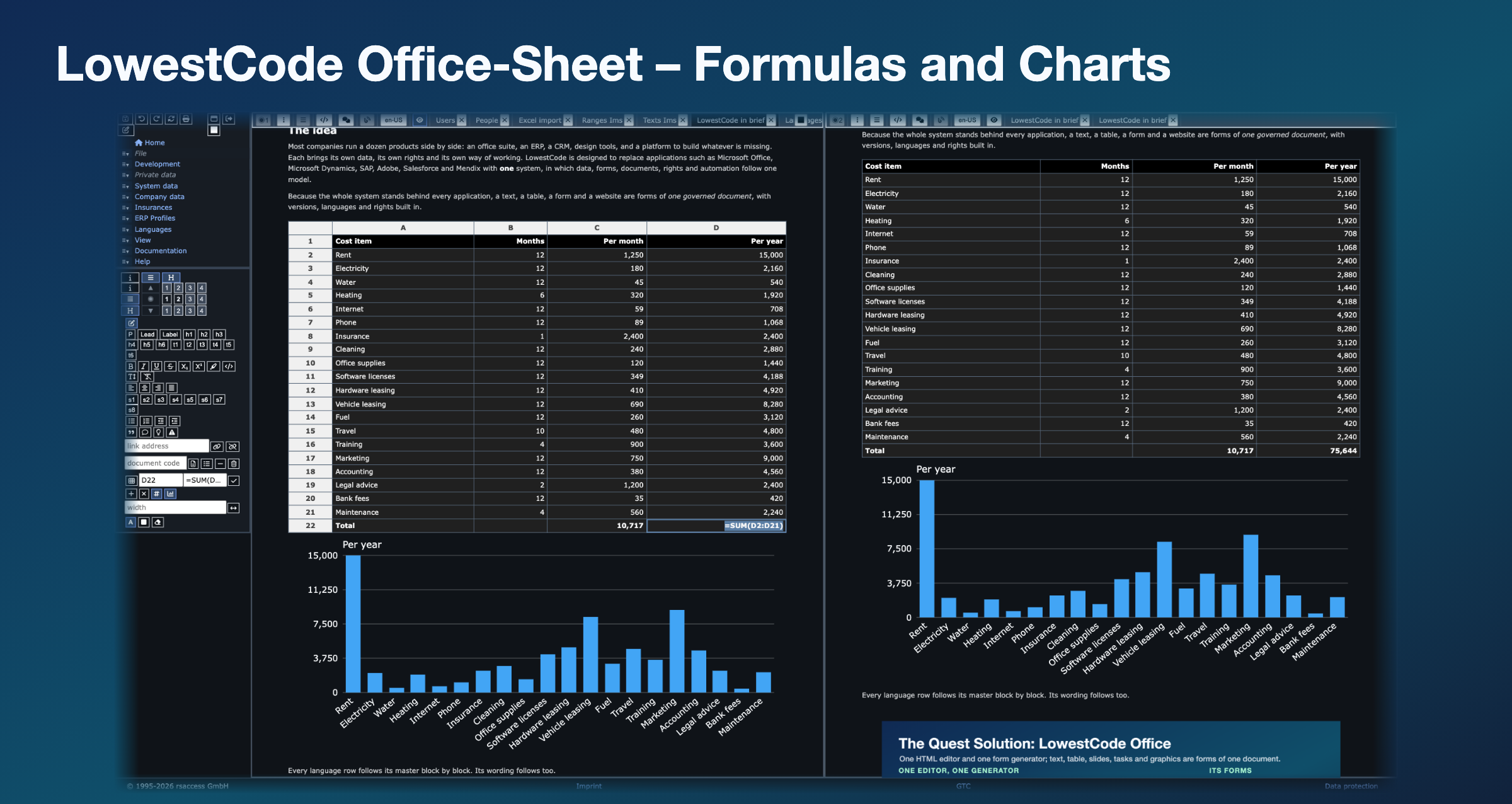
  • LowestCode Office-Sheet – Formulas and Charts. Screenshot of the LowestCode workplace in a dark theme: on the left the side menu with the HTML editor's toolbar and its sheet tools, the cell D22 and its formula; to its right two windows of the same document, each scrolled on its own. In the first the document is open in the editor, a sheet of twenty cost items with row numbers and column letters between the text above it and the text below, the total cell selected and showing its formula =SUM(D2:D21), and the bar chart of the yearly costs under it; the second shows the composed document, the same sheet with its values, the total 75,644 and the chart, the text around it and the Office figure below LowestCode Office-Sheet: a sheet with formulas and a chart inside the document, built for full RPA
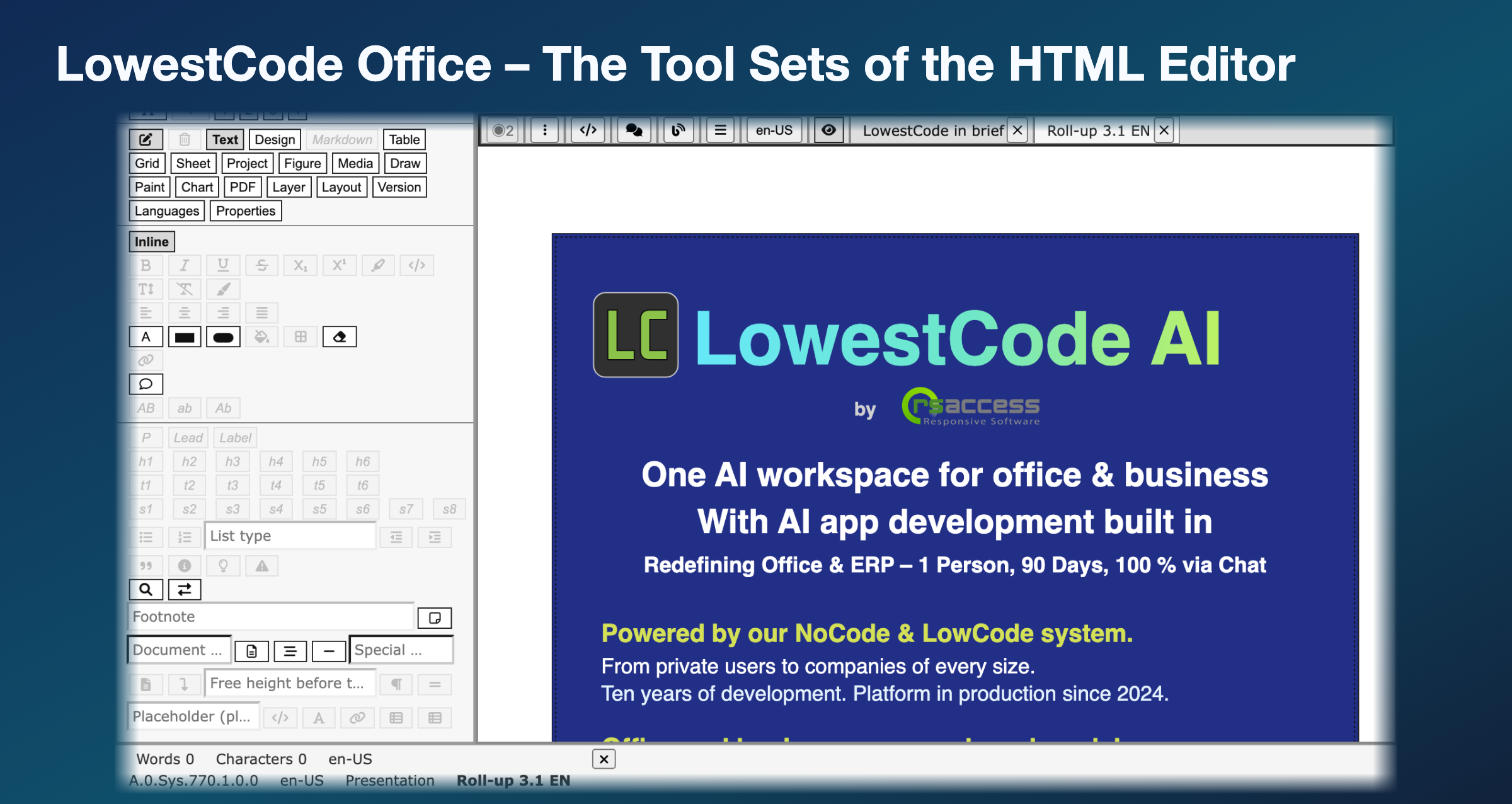
  • LowestCode Office – The Tool Sets of the HTML Editor. Screenshot of the LowestCode workplace in a dark theme while a text is edited: on the left the panel of the HTML editor with the headers of its tool sets, Text, Design, Markdown, Table, Grid, Sheet, Project, Figure, Media, Draw, Paint, Chart, PDF, Layer, Layout, Version, Includes, Binder, Languages and Properties, Text selected, below them the common section Inline with the marks, sizes, alignment, colors, link and comment, and the tools of Text: cut, copy and paste, paragraph, lead and label, headings, titles and sizes, lists, quote, note, tip and warning, find and replace, footnote, the document include, the special character and the placeholders, most of them active; on the right the document LowestCode in brief open in the editor, three words of a paragraph selected with the tools at the selection above them, and the start of a sheet below LowestCode Office tool sets: the tools of the HTML editor, active while a text is edited
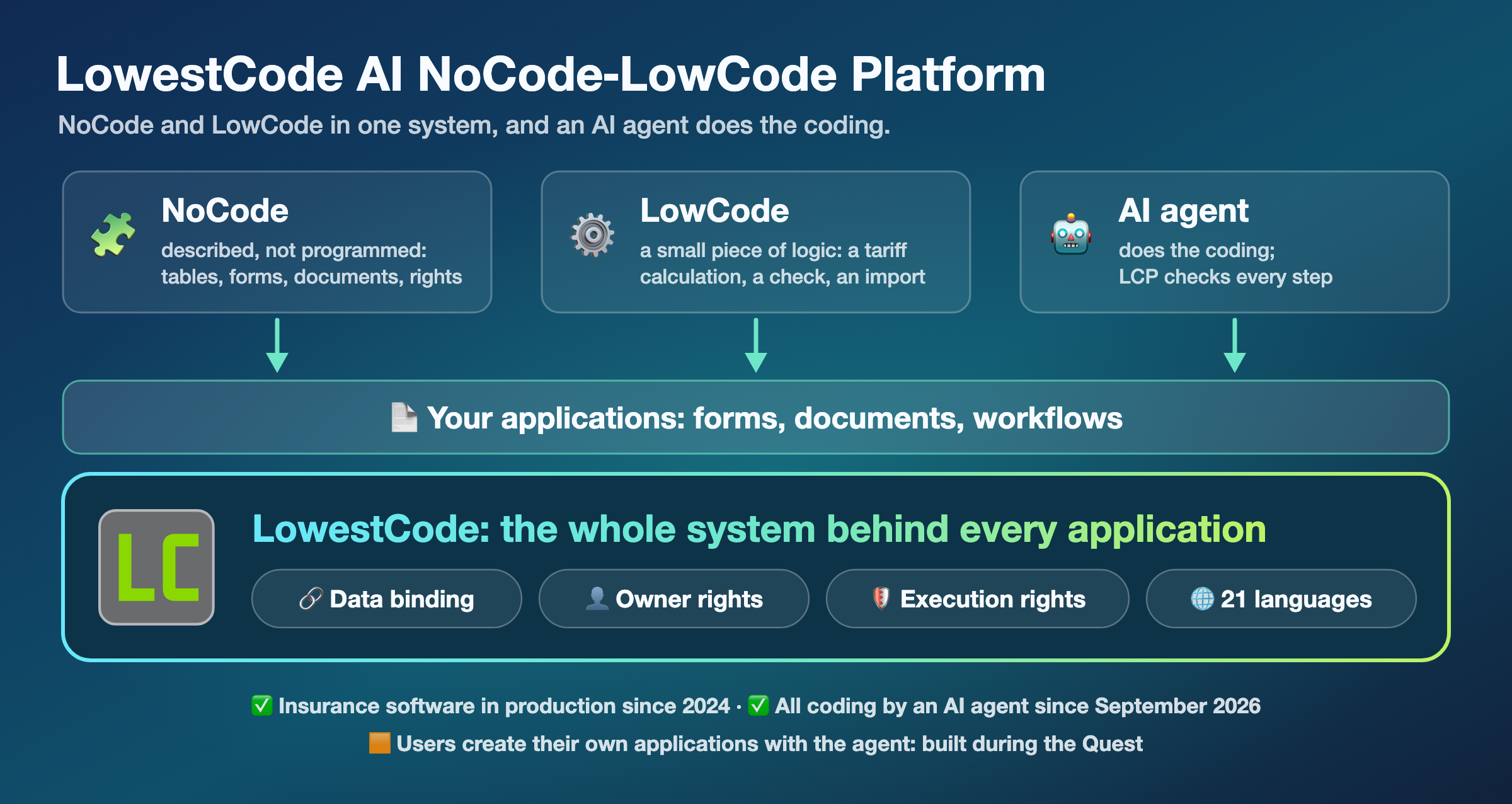
  • LowestCode AI NoCode-LowCode Platform: NoCode and LowCode in one system, and an AI agent does the coding. Three ways to build: NoCode, described, not programmed, with tables, forms, documents and rights; LowCode, a small piece of logic such as a tariff calculation, a check or an import; and the AI agent, which does the coding while LCP checks every step. They lead to your applications, forms, documents and workflows, and below them stands LowestCode, the whole system behind every application, with data binding, owner rights, execution rights and 21 languages. Insurance software in production since 2024, all coding by an AI agent since September 2026; users creating their own applications with the agent is built during the Quest NoCode, LowCode and AI: the whole system behind every application
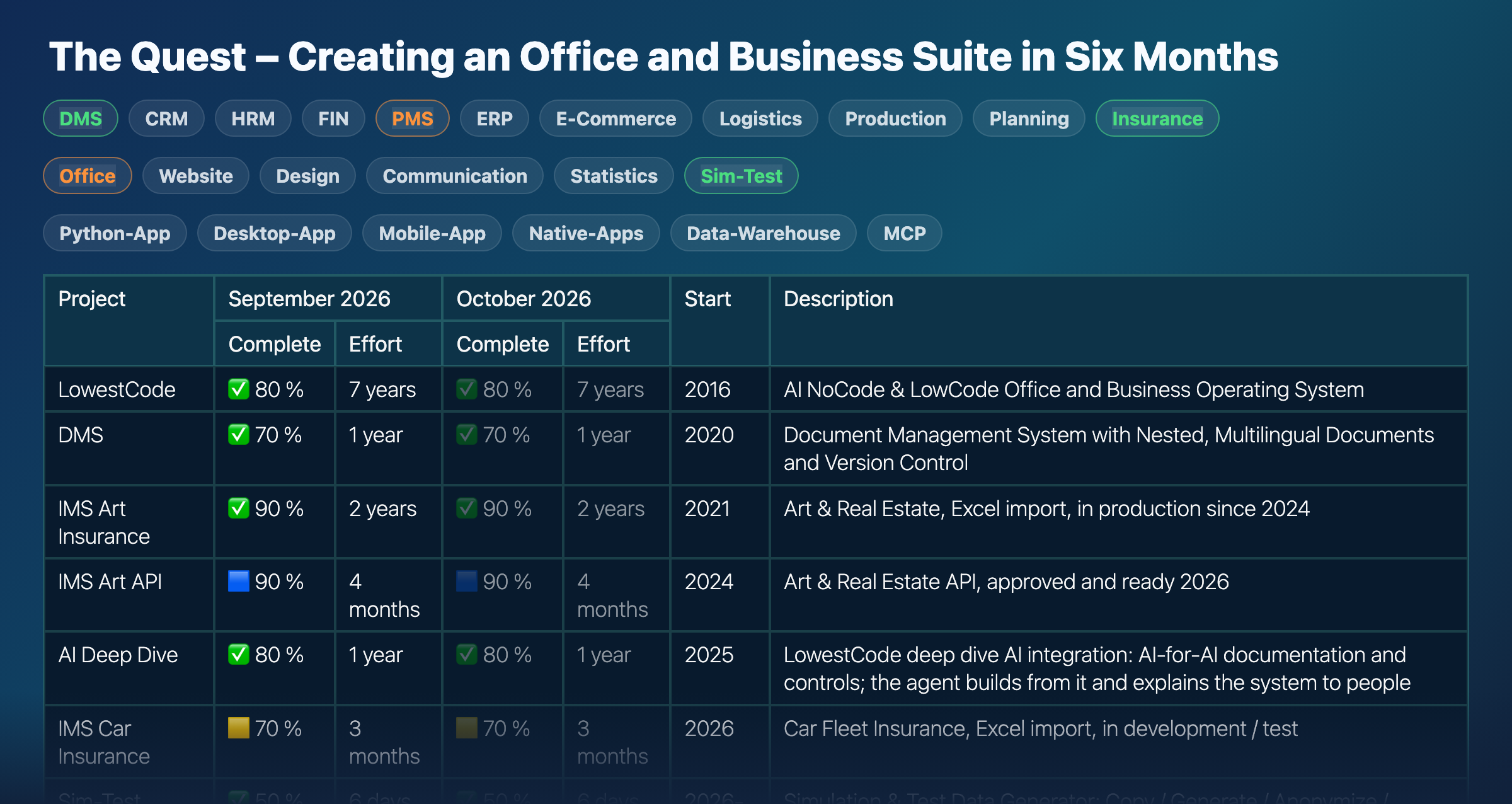
  • The Quest – Creating an Office and Business Application in Three Months: the project pills in three rows, planned and in work, and the monthly project table with completeness, effort, start and description per project The Quest – updated every month
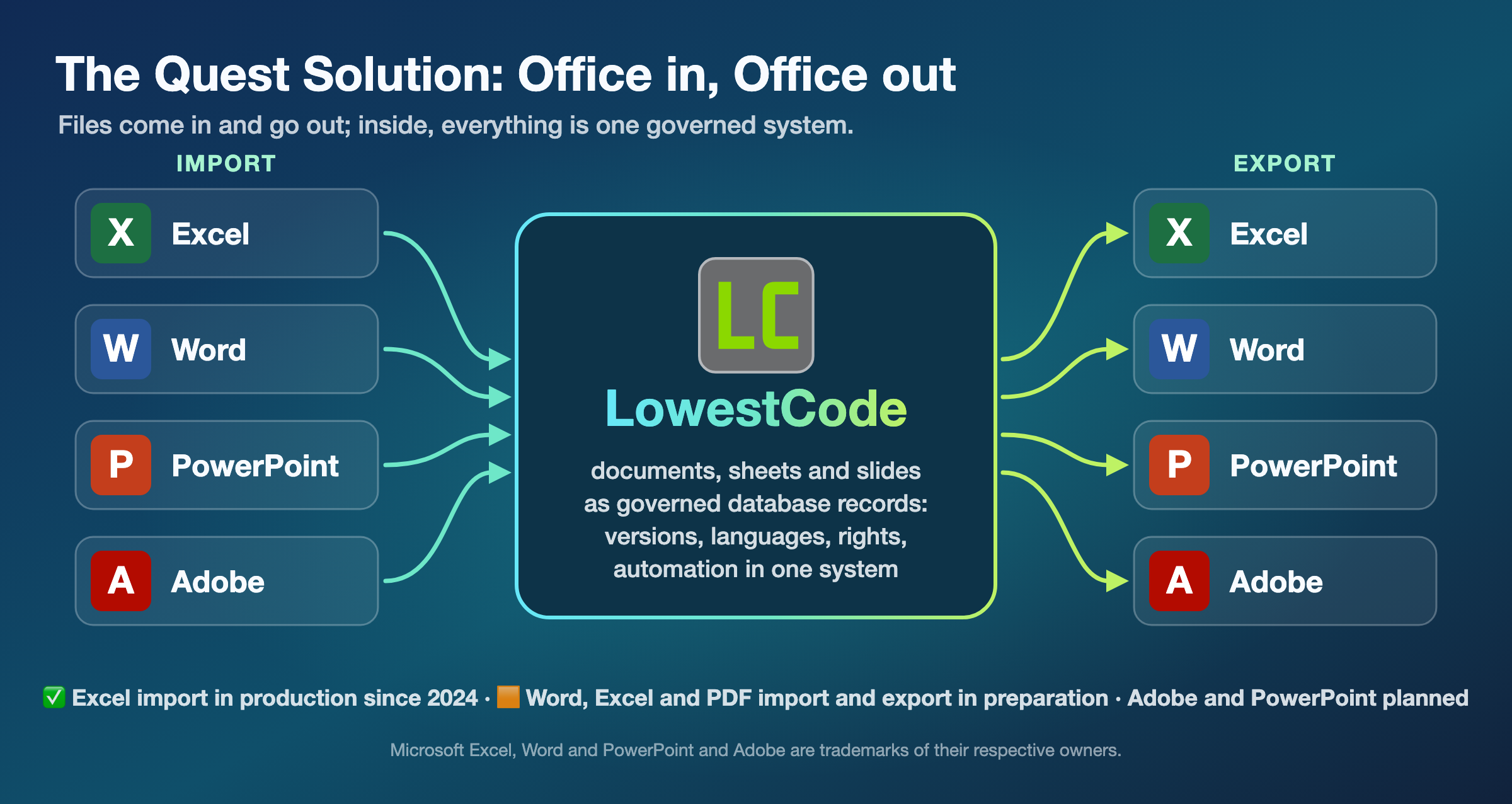
  • Office in, Office out. Excel, Word, PowerPoint and PDF files are imported into LowestCode, where documents, sheets and slides are governed database records with versions, languages, rights and automation in one system, and exported to the same formats; Excel import in production since 2024, Word, Excel and PowerPoint files come in and go out, and every print is a PDF Import and export with Office tools
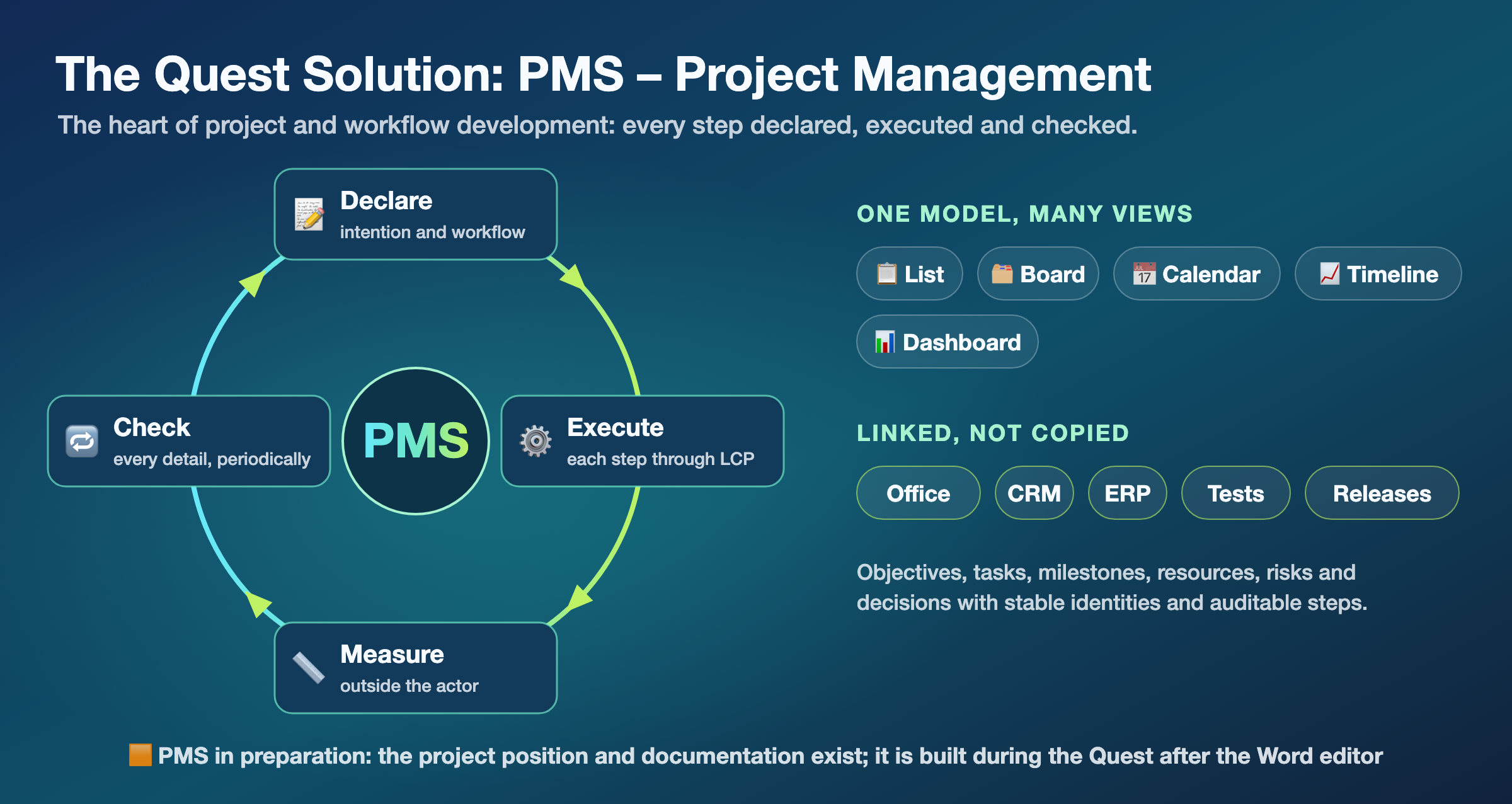
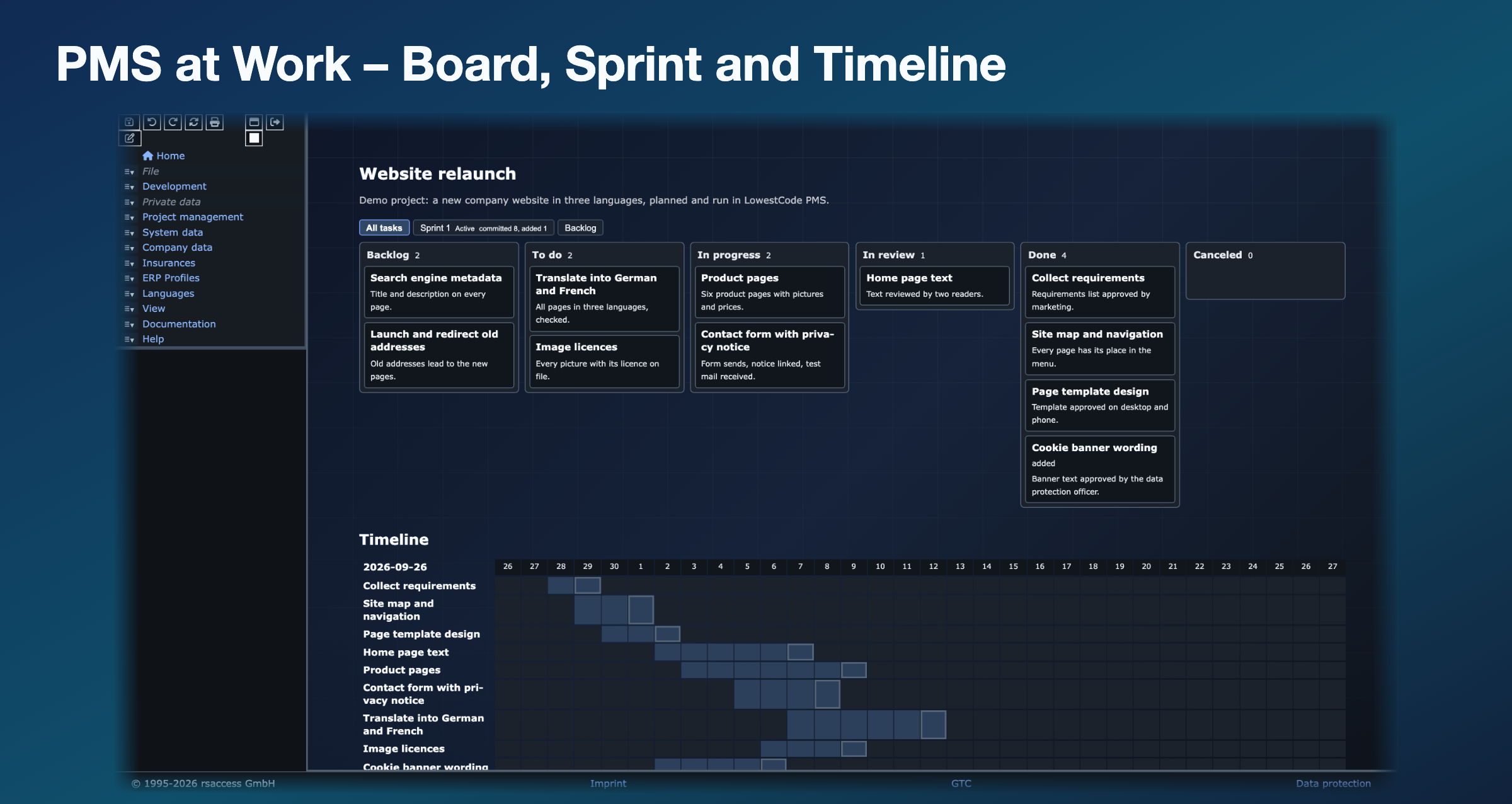
  • PMS – Project Management, the heart of project and workflow development. A cycle around PMS: declare the intention and the workflow, execute each step through LCP, measure outside the actor, check every detail periodically; one model with list, board, calendar, timeline and dashboard views, linked to Office, CRM, ERP, tests and releases; PMS in production for our own development since October 2026, the bindings to CRM, ERP and the business applications follow in the Quest PMS: projects and workflows, declared and checked
  • PMS at Work – Board, Sprint and Timeline. Screenshot of LowestCode PMS at work with a demo project, Website relaunch: the board with the columns backlog, to do, in progress, in review, done and canceled, each task a card with its title and the measurement that closes it, the filter of Sprint 1 with eight committed tasks and one added, and below it the timeline with a bar from start to due date for every task PMS at work: a demo project on the board, with its sprint and timeline
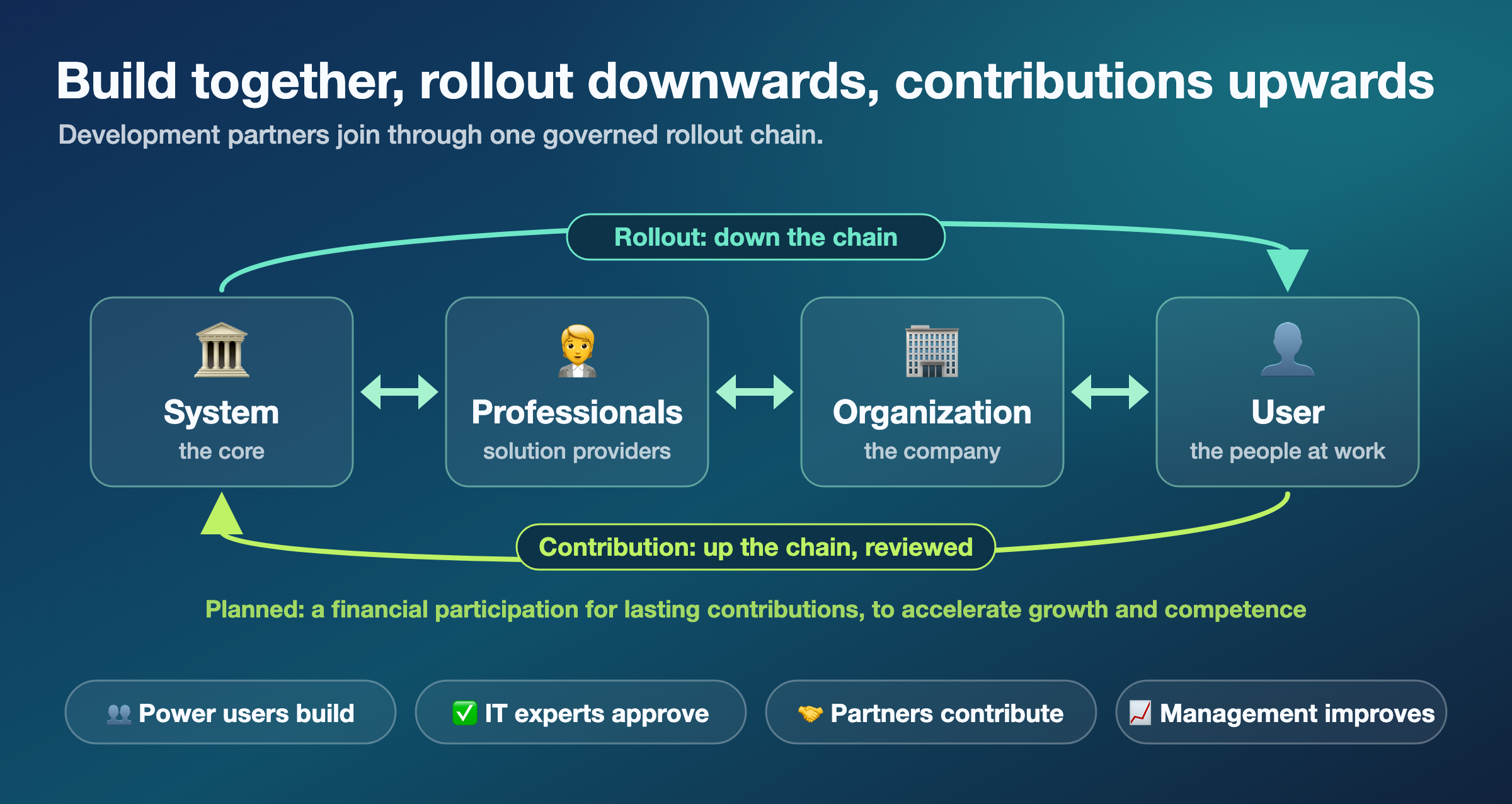
  • Build together, rollout downwards, contributions upwards: the four levels System, Professionals, Organization and User, the rollout down the chain and the reviewed contributions up the chain, a planned financial participation for lasting contributions to accelerate growth and competence, and power users build, IT experts approve, partners contribute, management improves; the note: in LowestCode development, the Organization level is played by the insurance use case, in practice since 2024 The rollout and contribution chain
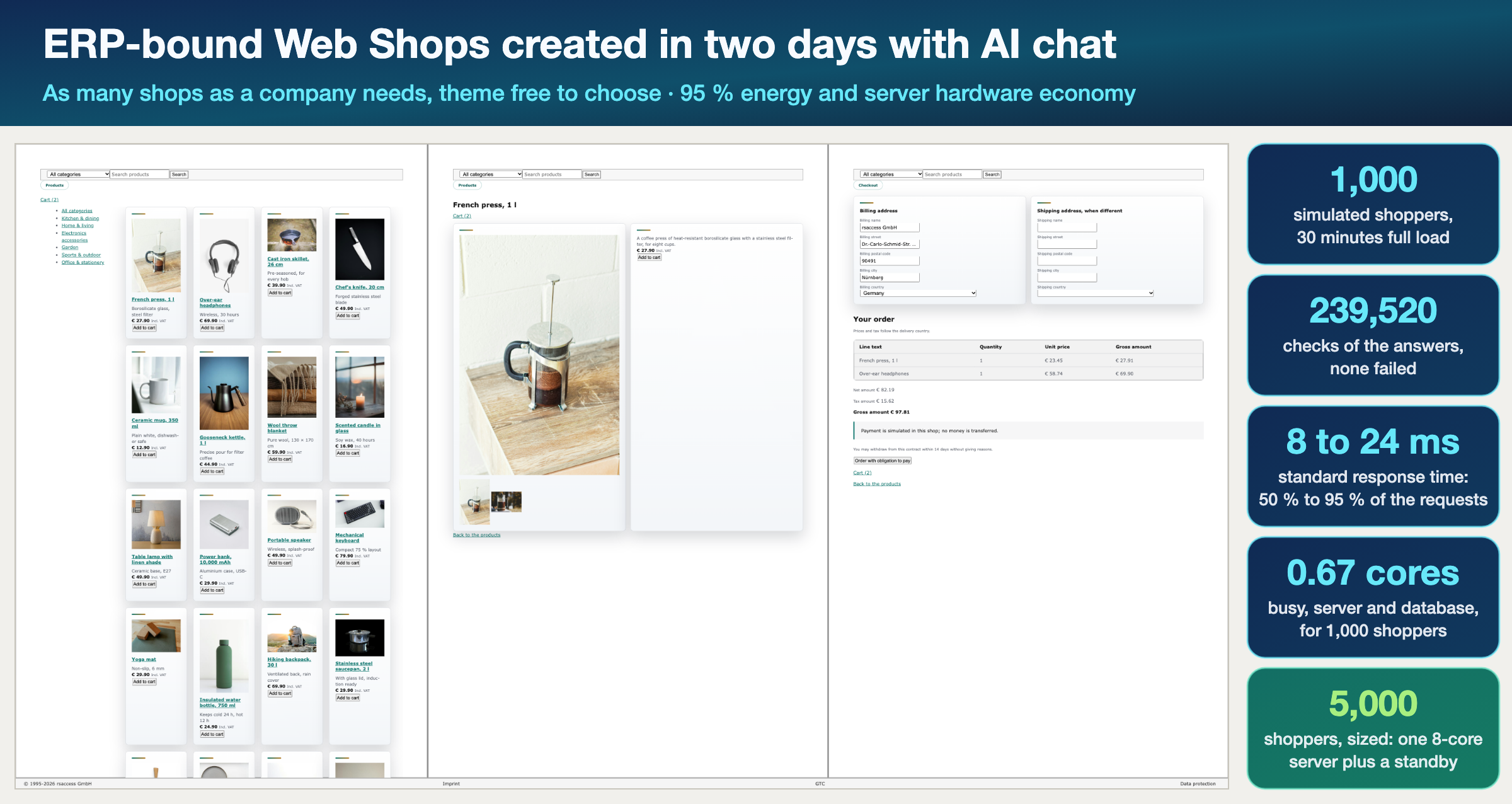
  • ERP-bound Web Shops created in two days with AI chat. As many shops as a company needs, theme free to choose; 95 % energy and server hardware economy. On the left a screenshot of three windows of the LowestCode workplace in a light theme: the product list with the categories of the shop and the product cards with their pictures, the product page of the French press with its picture, and the checkout with the order and the note that the payment is simulated. On the right the load test of the shop: 1,000 simulated shoppers for 30 minutes of full load, 239,520 checks of the answers with none failed, 8 to 24 ms standard response time for 50 % to 95 % of the requests, 0.67 processor cores busy for server and database, and, sized, 5,000 shoppers on one 8-core server plus a standby ERP-bound web shops, created in two days with AI chat and load-tested.
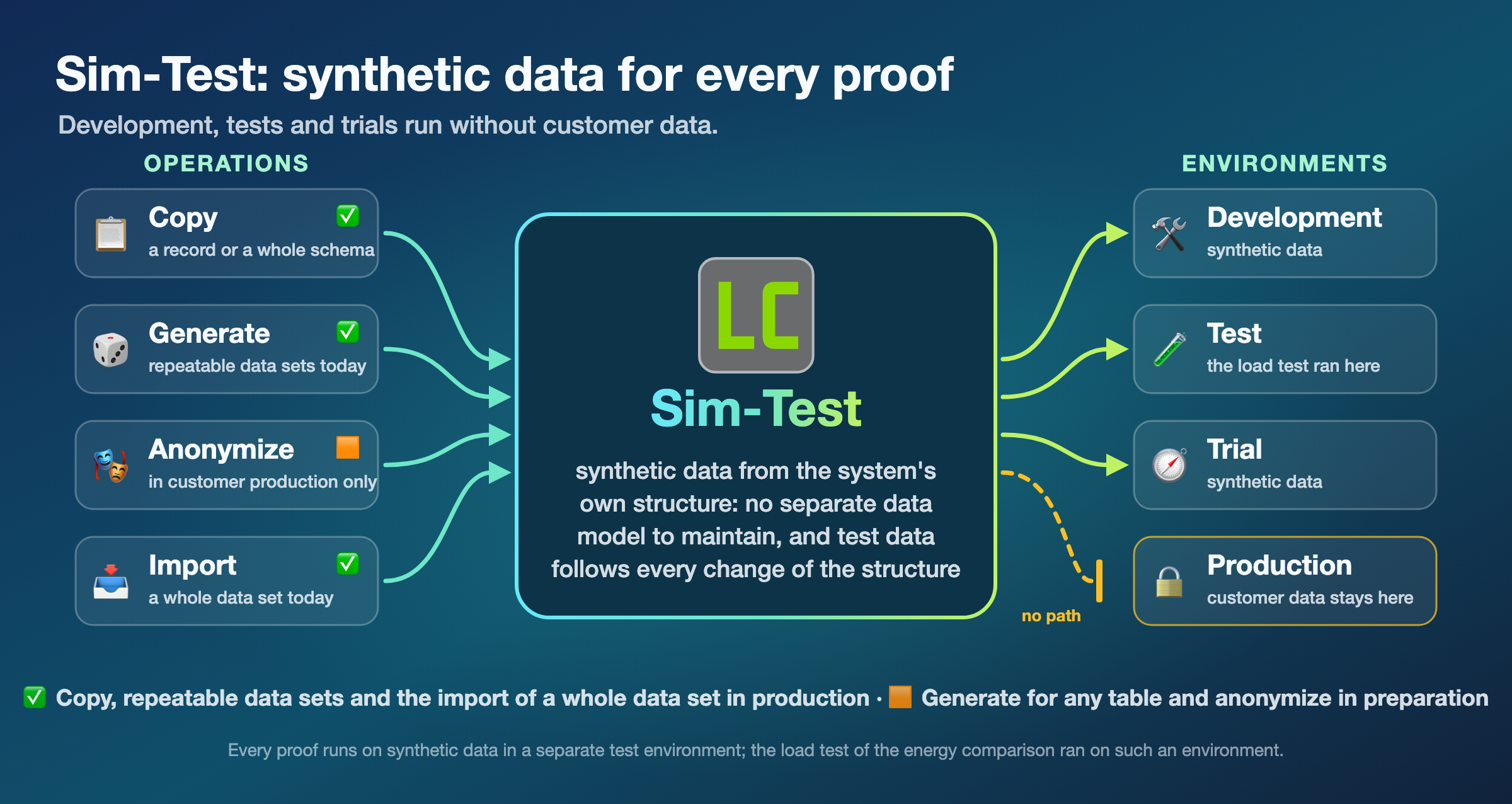
  • Sim-Test: synthetic data for every proof. Four operations, Copy a record or a whole schema, Generate repeatable data sets today, Anonymize in customer production only, and Import a whole data set today, feed Sim-Test, synthetic data from the system's own structure with no separate data model to maintain; it flows into the development, test and trial environments, where the load test ran, and no path leads to production, where customer data stays. Copy, the generation of repeatable data sets and the import of a whole data set in production; generate for any table and anonymize in preparation Sim-Test: synthetic data for development, test and trial
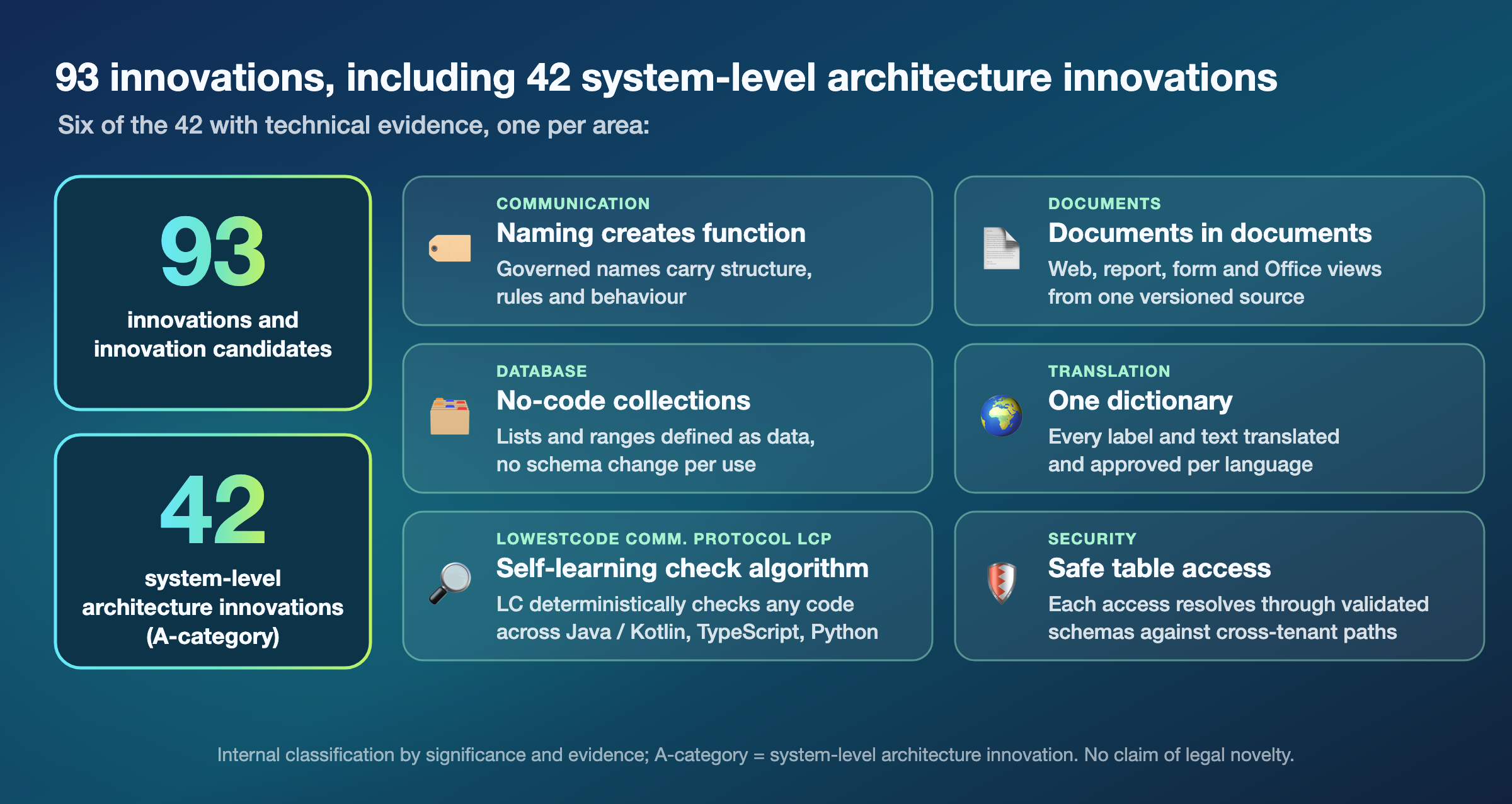
  • 94 innovations, including 43 system-level architecture innovations (A-category); what they deliver, one example per area: one meaning everywhere for people, software and AI; everything is a document, web pages, reports, forms and Office files in one system; no-code lists, rates and parameters changed without programming; 21 languages from the start with right-to-left scripts, time zones and customer-specific wording; controlled AI coding with every step checked and the rights decided before anything runs; tenants kept apart, each customer's data isolated by design; power users deliver, the people who know the work shape forms, lists and workflows without code; and, set apart for your budget and not counted as an innovation, no license fees for components, every third-party component free open source, AI and hosting external; an internal classification, no claim of legal novelty Innovation and cooperation
  • Our range
  • Unified System
  • Green tech
  • Your team
  • Office
  • Workplace
  • ERP
  • Sim-Test
  • Cooperation
  • Summary

LowestCode AI brings Office, ERP, e-commerce, and software development into one workspace. Individuals and businesses get work done and create or extend applications as needed through AI chat.

All LowestCode office and business applications are lightweight, clean, and fast—secure, privacy-focused, and multilingual by design, with 21 languages from the start. They run in European cloud environments or on desktops and are designed to support compliance with EU requirements for data protection, cybersecurity, and AI.

Our objective is a fully automatable system with a clear, well-structured architecture, enabling end-to-end automation of office work, business processes, and application development.

No more manual coding for professionals and users: coding, project management, and testing run entirely through AI chat under LowestCode’s controls, supported by a transparent architecture made for AI.

A green revolution for business software: on average, 95 % less energy use and server hardware than six leading business systems, based on our own load measurements and estimated sizing for those six systems.

Build together, roll out downwards, contribute upwards: system developers, IT service providers, customer organizations, and users develop independently without interfering with one another, supported by automated rollouts and controlled contributions.

LowestCode is designed to replace applications such as Microsoft Office, Microsoft Dynamics, SAP, Adobe, Salesforce, and Mendix, bringing office work, business operations, design, and application development into one integrated system.

Users adapt and optimize their workflows and applications by talking with the integrated AI agent, which respects the permissions for documents, forms, and users.

All product names are trademarks of their respective owners.

Our range

One system in place of many applications What LowestCode is designed to replace, and where each part stands today.

Companies run their work on many separate applications: an office package, an ERP, a CRM, design tools and a platform to build their own. LowestCode is designed to replace them with one system, and to go beyond them: built new, without the legacy of decades, with a modern workplace of several windows side by side, faster work in the cloud and professional options from the start. The map shows where each part stands today.

The whole range of LowestCode

  • DMS
  • CRM
  • HRM
  • FIN
  • PMS
  • ERP
  • E-Commerce
  • Logistics
  • Production
  • Planning
  • Insurance
  • Office
  • Website
  • Design
  • Communication
  • Statistics
  • Sim-Test
  • Gaming
  • Learning
  • Java-App
  • Python-App
  • Desktop-App
  • Mobile-App
  • Native-Apps
  • Data-Warehouse
  • LCP
  • MCP adapter

The color of a pill shows the state of its project: in production, in test or in preparation; a pill without color is planned.

✅ In production · 🟨 In test · 🟧 In preparation · ⬜ Planned · As of 12 November 2026

What it is designed to replace

The percentage is our estimate of how much of each project's planned scope is built, not a comparison with the named product.

Designed to replace
LowestCode part
State · planned scope built
Effort so far
Microsoft Office
Office work
Office-Text
Office-Sheet
Office-Table
Office-Layout
Office Design
✅ 95 %
✅ 90 %
🟨 85 %
✅ 90 %
✅ 85 %
28 days
12 days
2 days
4 days
4 days
Adobe
Design, graphics, PDF
Design, Draw, Paint
and PDF tools
✅
–
Microsoft Dynamics, SAP
ERP
ERP
FIN
ERP Web Shop
🟨 30 %
🟨 30 %
✅ 60 %
2 days
< 1 day
4 days
Salesforce
CRM
CRM
Planned
–
Mendix
Application building
LowestCode
LCP-Chat
LCP *
MCP adapter *
✅ 80 %
✅ 50 %
✅ 45 %
🟧
6 years
6 days
2 days
–
And more
Projects, documents, test data
PMS
DMS
Sim-Test
✅ 50 %
✅ 75 %
✅ 55 %
4 days
1 year
6 days

State and effort come from the project table of the Quest. Effort is the running time of the work, the time elapsed, rounded; 10 hours count as one day. A dash marks a part without a value of its own; the tools of Office are described under Office tool sets. * LCP is in production; the MCP adapter, the adapter for the external Model Context Protocol, is in preparation.

All product names are trademarks of their respective owners.

An application, not a suite

A suite bundles separate products, a word processor beside a spreadsheet, an ERP beside a CRM, each with its own data, rights and screens, joined by interfaces. LowestCode is one application: documents, sheets, business data, rights and versions live in one shared model, so a new part extends the application instead of adding a product to connect.

The Quest: public proof of the system and of high-speed development

October to December 2026: one AI agent, guided by one human, creates the Office and Business Application, and the state and the effort of every project are published month by month. The map and the pills take their values from it.

Follow the Quest
Unified System

The AI agent codes. LowestCode controls. 100 % AI chat execution in one LowestCode system: coding, project management, and testing. Simultaneously, controlled and safe.

An automation engineer's approach, not an IT one: every operation is a defined step, checked before it acts and measured after it, as in a plant. Data, code and user interface form one model, every change runs with its rights decided first, and its result is measured outside the agent. That is why the agent can code, structure and test the whole system safely, and why every step of the system can be automated.

LowestCode Unified Development System: coding, project management, testing 100 % by AI and LCP. Left, traditional, separated teams and tools: the user passes a need to project management teams A, B and C, each with its project app; they coordinate with coding teams, API teams and test teams, each with its own apps; a release by the operations team puts the result into two databases and two separate user interfaces; every handoff takes days, weeks or months, and the feedback returns to the user after days, weeks, months. Who can learn from whom? Right, LowestCode, one unified system: users, project management, development, testing, business applications and Office and documents stand around one circle, each connected by a double arrow to the band of AI, NCLC, LCP and Test, which is attached to the core of data, code and UI. One core for everyone, self-learning and controlled: no handoffs, results at once
Traditional development passes a need through project, coding, API and test teams, each with its own apps, and the feedback takes days to months. LowestCode is one system: every party works with one core of data, code and UI through AI on NCLC and LCP, and tests run apart from production.

LowestCode is what AI needs: NoCode and LowCode in one integral, compact system for Office and business applications, and LCP controls every step. The result is controlled agent coding, high coding efficiency, and a clear interface for people.

The platform explained Technical data
Green tech: energy and server hardware

95 % less energy and server hardware on average Documented resource efficiency: own load measurements and estimated sizing for six leading business systems; SAP comes closest with in-memory.

LowestCode keeps about one core busy for 1,000 users, measured; sized with headroom and a standby, that is four cores, eight with high availability on two sites. Five of the six other systems need far more, estimated from their published sizing rules, benchmarks and typical landscapes.

LowestCode power and server hardware comparison: server cores and watts per 1,000 users for LowestCode and six providers, each a range from single operation to a high-availability landscape, LowestCode sized from its measured load, with the mean of each range marked
  • 1.4 billionrows read by the database in one run
  • 30 minutesof full load
  • 171,000checks of the answers, none failed
  • 9 to 136 msstandard response time: 50 % to 95 % of the requests
  • ≈ 5 wattsprocessor power, load generator included

The web shops were measured the same way; their figures stand in the web shop picture and the load test report.

Provider comparison Load test report Security Economy

The numbers, their sources and the measurement are on these pages; no competitor product was measured. All product names are trademarks of their respective owners.

Your team with LowestCode

Power users deliver.
IT experts guide. Development partners join through one governed rollout chain.

The LowestCode rollout system lets development partners build independently without interfering with one another, as the integrated AI agent does the coding and keeps it consistent.

Rollout
  1. System
  2. Professionals
  3. Organization*
  4. User

We roll out code and data: documents and information such as taxes and legal information, where each customer can choose which services to implement.

Contributions travel up the chain in a controlled way. Once we are established on the market, we plan a participation system that rewards lasting contributions.

Contribution
  1. User
  2. Organization*
  3. Professionals
  4. System

In addition, every partner installation rolls out from local development to production.

* In LowestCode development, the Organization level is played by the insurance use case, in practice since 2024.

Office

LowestCode Office at work Text documents, tables, presentations, notes, reports and websites are forms of one governed document, not separate programs.

LowestCode Office is the working surface of the system, with the HTML editor and the form generator at its core: documents are written in the editor, forms are generated by the system rather than programmed, and both keep their rights, versions and languages in the system.

LowestCode Office – The Tool Sets of the HTML Editor. Screenshot of the LowestCode workplace in a dark theme while a text is edited: on the left the panel of the HTML editor with the headers of its tool sets, Text, Design, Markdown, Table, Grid, Sheet, Project, Figure, Media, Draw, Paint, Chart, PDF, Layer, Layout, Version, Includes, Binder, Languages and Properties, Text selected, below them the common section Inline with the marks, sizes, alignment, colors, link and comment, and the tools of Text: cut, copy and paste, paragraph, lead and label, headings, titles and sizes, lists, quote, note, tip and warning, find and replace, footnote, the document include, the special character and the placeholders, most of them active; on the right the document LowestCode in brief open in the editor, three words of a paragraph selected with the tools at the selection above them, and the start of a sheet below
The tool sets of the HTML editor while a text is edited, in a dark theme: a few words are selected, so the common Inline section and the tools of Text are active, and the tools at the selection stand above the paragraph. Screenshot of the development system, November 2026.
  • Text
  • Design & Publish
  • Markdown
  • Table
  • Grid
  • Sheet
  • Project
  • Figure
  • Media
  • Draw
  • Paint
  • Chart
  • PDF
  • Layer
  • Layout
  • Version
  • Binder
  • Languages
  • Properties
  • Forms
  • Secure Document AI Chat Agent
  • Themes & Formats

Import and export: Word, Excel, PowerPoint and PDF are formats LowestCode Office imports and exports with its own means; the document itself, with its rights, versions and languages, stays in the system. All product names are trademarks of their respective owners.

Data protection and security by design

A LowestCode document is not a file on a disk or a share. It lives in the system, so the same rights, owners and versions decide who reads and changes it, people and the AI agent alike. A Word, Excel or PDF file is an export, not the document. Data protection and security come from how Office is built, not from a feature added afterwards.

The Office project
The workplace. The development IDE.

One workplace.
One development IDE.
Many windows. One shell for any application, LowestCode Office included.

Your windows, ready when you log in

From a single window to a complex working and development environment, the workplace fits the task. Your windows and their layout are saved and preloaded, ready the moment you log in. Working environments can be defined for each task and guarded by rights. Windows sit side by side, and the same document can be open in many of them, working in sync. The same system is your workplace and your development and test environment, so you build your own applications there and test them on synthetic data before they reach production. The test environment is independent of production, separate in data and files, and always available and accessible.

One menu, two views, one toolbar

The navigation is one menu shown two ways, as a side tree or as a top menu. The side menu doubles as the toolbar, with the HTML editor's controls in it, as on the left of the picture. Themes and formats change the look, not the content.

The development IDE inside the workplace

The development IDE is not a separate program. It uses the same multi-window workplace: the code walkthrough opens beside the forms and documents of the day, visible to developers by rights and invisible to everyone else. Users work in the normal workplace and never meet the coding capability.

Multi-Window Workplace – Choose Your Theme: three workplace windows in three themes: the people table with the side navigation tree, the insurance administration with its child lists for risk locations and valuables under the top menu, and the user form with its field groups
Workplace views in three themes: people with the side navigation and the HTML editor's toolbar, insurance administration with risk locations and valuables under the top menu, and the user form. Screenshots of 2025; the Office sections below show the workplace of today.
ERP

An ERP for industry, from the order to the machine Trade, production, machine building and logistics in one system, built on a real industrial business.

We build the ERP on a real business: a metal profiling company that trades and sells online, profiles steel from the coil, sends profiles out for coating, builds machines for itself and for its customers, maintains them, takes on robot automation projects, and runs its own logistics and transport. The web shops are part of the ERP: their pages show the products, prices and taxes the back office maintains, as they stand at the moment of the view, and every order lands with its lines, addresses and payment where the back office works with it.

ERP-bound Web Shops created in two days with AI chat. As many shops as a company needs, theme free to choose; 95 % energy and server hardware economy. On the left a screenshot of three windows of the LowestCode workplace in a light theme: the product list with the categories of the shop and the product cards with their pictures, the product page of the French press with its picture, and the checkout with the order and the note that the payment is simulated. On the right the load test of the shop: 1,000 simulated shoppers for 30 minutes of full load, 239,520 checks of the answers with none failed, 8 to 24 ms standard response time for 50 % to 95 % of the requests, 0.67 processor cores busy for server and database, and, sized, 5,000 shoppers on one 8-core server plus a standby
The common shop at work in three windows of the workplace, the product list, the product page and the checkout, with its load test on the right. Screenshot of the development system, October 2026.
The ERP project
Simulation and test

Sim-Test: synthetic data for every proof What a company gets from it: data checks, security, load checks and planning simulations.

Every company needs this, and most ignore it: software has to be proven before real data and real money depend on it, and proven without handing customers' data to developers, testers or an AI. Sim-Test makes both possible: synthetic data in the shape of your business, generated from your own structures.

The Sim-Test project
Innovation and cooperation

A structured innovation portfolio grounded in working software Deterministic AI, internationalization, digital sovereignty, and measurable efficiency.

We have structured a portfolio of 94 innovations and innovation candidates, including 43 system-level architecture innovations (A-category). They rethink how database semantics, documents and interfaces, automation, AI governance, security, and deployment work together. On this basis we are preparing a research grant application to the German research ministry (BMFTR, formerly BMBF) and are looking for a university partner.

For customers: What we modernize.

The business

Model: we deliver the technology, and partners bring it to customers. Revenue comes from licenses per user and month, through partners and direct, and from building applications for customers with the AI agent.

First market: mid-sized companies, insurers and organizations in the German-speaking countries that modernize Office work, processes, Excel and VBA. We enter through concrete projects.

Market: Office and ERP are the core markets; Gartner forecasts USD 58.2 billion for low-code technologies worldwide in 2029 (forecast analysis of November 2025).

Expansion: partners offer LowestCode as their own application layer; AI providers and cloud hosts add it to their models and hosting.

Investment: we are looking for strategic investors who are partners as well, and for business angels. The funds go mainly into marketing and sales, then into partner engineering and operations, toward one goal: LowestCode in common use, nationally and across Europe.

Discuss your project Partners and investors
Summary

LowestCode in short One integral, compact system for Office and business applications, and LCP controls every step. Many problems solved.

In use and measured today

  • ✅Ten years of development, proven in real use: insurance software certified and in production since 2024 at an international insurance group, with due diligence passed and labor union approval.
  • 🧠We don't write code anymore: since September 2026, coding, project management and testing run 100 % by AI chat, on the NoCode & LowCode (NCLC) system with the LowestCode Communication Protocol (LCP), which checks each request before it runs.
  • ⚡About one busy core for 1,000 users, measured: in one 44-minute load run, 30 minutes of it at full load, the database reads more than 1.4 billion rows, and the device does not even get warm.
  • ⚡Green tech: 95 % less energy and server hardware on average than six leading business systems, from our own load measurements and estimated sizing for the six; SAP comes closest with in-memory.
  • 🌍21 application languages from the start, and each partner can add languages or define dialect variants; right-to-left scripts, time zones and country formats are built in.
  • 🆓No license fees for components: every third-party component is free open source. AI agents and cloud hosting are external services with their own terms.

How it works

  • 📄Office, business applications and ERP in one workspace: LowestCode Office stands built since 8 November 2026 and is in our own use, and the ERP with its web shops is being built in the same system.
  • 🏅One rollout and contribution chain: System ⬌ Professionals ⬌ Organization ⬌ User. Partners build independently, and contributions travel back up in a controlled way.
  • ⚙️An automation engineer's approach toward a fully automatable system: every operation is a defined step, checked before it acts and measured after it, as in a plant, and people, workflows and the AI agent run the same steps.
  • 🔒Data protection and security by design: every document and record keeps its rights, owners and versions in the system, for people and the AI agent alike; development and test run on synthetic data. Designed for the EU rules: GDPR and EU cybersecurity for the cloud, the EU AI Act for the AI.

We set the direction. AI agents code. LCP controls.

Discuss your project

© 1995-2026 Dr.-Ing. Raimund Reisacher – LowestCode technology
German patent application DE 10 2021 103 571 – relational database system, pending
© 1995-2026 rsaccess GmbH – LowestCode website, marketing and sales

+¦r2c1-s02-code¦+
+¦r2c1-s02-toc¦+
+¦r2c1-s02-doc¦+
+¦r2c1-s03-code¦+
+¦r2c1-s03-toc¦+
+¦r2c1-s03-doc¦+
+¦r2c1-s04-code¦+
+¦r2c1-s04-toc¦+
+¦r2c1-s04-doc¦+
+¦r2c1-s05-code¦+
+¦r2c1-s05-toc¦+
+¦r2c1-s05-doc¦+
+¦r2c1-s06-code¦+
+¦r2c1-s06-toc¦+
+¦r2c1-s06-doc¦+
+¦r2c1-s07-code¦+
+¦r2c1-s07-toc¦+
+¦r2c1-s07-doc¦+
+¦r2c1-s08-code¦+
+¦r2c1-s08-toc¦+
+¦r2c1-s08-doc¦+
+¦r2c1-s09-code¦+
+¦r2c1-s09-toc¦+
+¦r2c1-s09-doc¦+
+¦r2c1-s10-code¦+
+¦r2c1-s10-toc¦+
+¦r2c1-s10-doc¦+
+¦r2c1-s11-code¦+
+¦r2c1-s11-toc¦+
+¦r2c1-s11-doc¦+
+¦r2c1-s12-code¦+
+¦r2c1-s12-toc¦+
+¦r2c1-s12-doc¦+
+¦r2c1-s13-code¦+
+¦r2c1-s13-toc¦+
+¦r2c1-s13-doc¦+
+¦r2c1-s14-code¦+
+¦r2c1-s14-toc¦+
+¦r2c1-s14-doc¦+
+¦r2c1-s15-code¦+
+¦r2c1-s15-toc¦+

General Terms and Conditions of rsaccess GmbH

As of 2026-09-30 V1.0.1

This English version is a translation. In case of any discrepancy, the German version prevails.

  1. General
    1. These General Terms and Conditions (GTC) apply to rsaccess GmbH, hereinafter "rsaccess".
    2. Buyers and users are hereinafter referred to as the "Customer".
    3. The business purpose of the company is the development, consulting, training, sale, rental and service of software applications.
    4. rsaccess Server is the installation variant "local server".
    5. rsaccess Cloud is the application variant "Cloud-Server" or "Lowest-Cloud".
    6. rsaccess mobile App is the application variant "Cloud mobile App" (web technology for mobile devices) or "native mobile App" (e.g. iOS or Android apps).
    7. Documentation is available exclusively as a download and not in printed form.
    8. Software and data are available exclusively as a download.
    9. Licenses are bound to the Customer and are not transferable.
    10. These GTC apply only to entrepreneurs, legal entities under public law and special funds under public law (Section 310 (1) sentence 1 of the German Civil Code, BGB).
  2. Scope
    1. The following provisions apply to all legal transactions of rsaccess concerning the purchase, licensing, delivery, accompanying services and service of software. Conflicting terms of the Customer are rejected; they are binding only if we have expressly acknowledged them in writing before the contract is concluded. In all other respects, these GTC apply.
    2. These GTC also apply to all future transactions with the Customer.
  3. Offers and Orders
    1. Our offers are non-binding until we confirm an order in writing. Samples and specimens are non-binding general indications. The Customer ensures that rsaccess has all information required for consulting and preparing an offer.
    2. We are entitled to accept a Customer's offer to conclude a contract within four weeks of its receipt by us, unless the offer states otherwise. The scope of delivery is determined by our order confirmation.
    3. Our acceptance of the offer to conclude a contract requires text form to be effective.
    4. We are entitled to make partial deliveries, provided this is reasonable for the Customer.
    5. Trial deliveries are deemed accepted by the Customer as a firm purchase at the end of the agreed trial period, unless otherwise agreed in writing or the Customer returns the trial delivery to us within the trial period.
    6. If a service contract is concluded, the start of maintenance requires a chargeable update to the current version.
  4. Prices
    1. Our prices are net, plus statutory value-added tax, ex works, excluding packaging, insurance, postage, delivery costs and installation.
    2. If more than four months pass between the conclusion of the contract and delivery and prices increase in the meantime, we are entitled to charge the Customer the higher prices.
    3. License fees are due monthly on the first working day of the month.
  5. Terms of Payment
    1. The terms and deadlines of payment are governed by the respective order confirmation. Payment is made in time when it is received by us.
    2. If the Customer does not pay when due or if payments are deferred, outstanding amounts bear interest at 9 percentage points above the base interest rate. We reserve the right to claim further damages and other rights.
    3. The Customer may set off against our claims only with undisputed claims or claims established by final judgment. The same applies to rights of retention.
  6. Delivery
    1. All deliveries and services are made from the registered office of rsaccess, unless otherwise agreed.
    2. Periods agreed for deliveries and services begin upon receipt by the Customer, unless otherwise agreed.
    3. Delivery dates and delivery periods are binding only once we have confirmed them expressly and in writing.
    4. We are not liable for impossibility of delivery or for delays in delivery caused by force majeure. If such a delay lasts longer than six months, either party may withdraw from the contract.
  7. Retention of Title
    1. The goods delivered remain our property until all existing and future claims have been paid in full and may not be resold.
  8. Warranty
    1. All internal websites, descriptions and documentation have been prepared and checked with great care. Deviations between different platforms may occur in particular. We assume no liability for the correctness, completeness and timeliness of the content. Properties are deemed warranted only if they are expressly designated as such.
      The software may contain further, undescribed functions. There is no legal claim to these functions. Technical data without guarantee; technical changes reserved.
    2. If the products we deliver or the services we perform are defective, we will, in accordance with the statutory provisions and this Section 8, remedy the defect or provide a replacement at our discretion. Withdrawal due to defects is possible only after the second failed attempt at remedy. Claims for damages exist exclusively to the extent set out in Section 9. All replaced products become our property again.
    3. Claims based on defects become time-barred twelve months after the transfer of risk or after completion of the remedy.
    4. The Customer must inspect every delivered product without delay upon receipt. There is no warranty claim if complaints about the quantity delivered and about all defects recognizable on careful inspection have not been received by us in writing within eight working days of delivery; the same applies to complaints about hidden defects that have not been received within eight working days of their discovery.
    5. If a notice of defect proves unjustified, the Customer reimburses us for all expenses incurred as a result, provided the Customer is at fault.
    6. An installation, assembly or assembly service performed defectively by us is not a material defect within the meaning of the provisions on contracts of sale, but only a defect within the meaning of the provisions on contracts for work.
    7. Remedying the defect by the Customer is excluded.
    8. If the Customer does not provide or no longer provides the required environmental conditions, for example through changes to the operating system, runtime environment or firewall or through virus infection, the warranty lapses.
    9. All warranty claims of the Customer are reduced by the Customer's share of contributory fault resulting from deficient cooperation, preparation or other contributions for which the Customer is responsible.
  9. Liability for Damages
    1. Our liability, on whatever legal grounds, is limited to damage caused by us, our legal representatives or vicarious agents intentionally, through gross negligence or, where a material contractual obligation is breached, through slight negligence.
    2. Material contractual obligations are in particular the obligation to perform on time and free of defects and the duties of advice, protection and care intended to enable the Customer to use the delivered item in accordance with the contract or to protect the life or limb of the Customer's staff or third parties or the Customer's property from considerable damage.
    3. In cases of slight negligence, our liability is limited in amount to the damage typical for comparable transactions of this kind that was foreseeable at the conclusion of the contract or at the latest when the breach of duty was committed, excluding indirect damage.
    4. Claims for damages under the German Product Liability Act, for guaranteed characteristics or for injury to life, body or health remain unaffected by the above provisions.
    5. Consulting services are provided on the basis of the Customer's information and are non-binding. Legal, business or tax advice and any liability for it are excluded.
    6. rsaccess assumes no liability for the loss of programs or data. Data security and data protection are the sole responsibility of the Customer.
    7. All claims for damages of the Customer are reduced by the Customer's share of contributory fault resulting from deficient cooperation, preparation or other contributions for which the Customer is responsible.
  10. Refusal of Performance
    1. If a contract is not performed because of conduct of the Customer that is contrary to the contract and culpable, the Customer owes damages in the amount of the costs incurred by us, but at least 10 % of the net value of the goods under the contract, unless the Customer proves lower damage. The same applies if we withdraw from a concluded contract for this reason.
  11. Special Conditions for Delivery and Installation
    1. Installation and assembly costs, hourly rates, daily allowances, travel costs and other expenses are governed by the price list in force at the time.
    2. The required infrastructure must be ready before installation begins, so that installation can start immediately upon arrival. The rooms in which installation takes place must be well protected against the weather, well lit and sufficiently heated.
    3. The Customer must, at its own expense,
      1. provide auxiliary staff and skilled workers in the number and with the qualifications required to carry out the installation;
      2. keep ready the devices, tools, manuals and other instructions required for installation and commissioning.
  12. Special Conditions for Work Performance
    The following conditions apply insofar as our performance consists of work under a contract for work.
    1. Immediately after notice of completion of the work, the Customer must carry out a test run of the subject matter of the contract, examine it for the functionality and performance provided for in the contract and, unless defects appear, which must be reported without delay, declare acceptance of the work to us in writing within two weeks at the latest. If the Customer does not report a defect within this period, the work is deemed accepted when the period expires, with the consequence that the risk of performance passes to the Customer.
    2. At the Customer's request, we instruct the Customer's employees on site in the operation of the work. In this case, the Customer bears all costs of travel, accommodation and meals of the training staff and, where necessary, provides training rooms and protective clothing in sufficient quantity free of charge.
    3. Compliance with the planned delivery times requires that the Customer fulfils all contractual obligations to cooperate on time and properly. If the Customer does not fulfil them or does not fulfil them on time, the delivery times are extended by the duration of the delay.
    4. Details of the Customer's obligations to cooperate are governed by the underlying contract.
    5. Rights of the Customer in the event of defects after acceptance
      1. If the work proves defective, the Customer may demand subsequent performance, i.e. remedy of the defect or production of a new work. The choice between remedying the defect and producing a new work lies with us.
      2. After the unsuccessful expiry of a period set for subsequent performance, the Customer may remedy the defect itself and demand reimbursement of the necessary expenses, unless we have rightfully refused subsequent performance.
      3. If the remedy fails, if we refuse subsequent performance without justification or if we do not provide subsequent performance within a reasonable period set by the Customer, the Customer may reduce the remuneration or withdraw from the contract and demand reimbursement of futile expenses or damages in lieu of performance.
      4. The Customer has no rights on account of defects caused by incorrect operation or maintenance of the work or by changes to the work made by the Customer or a third party. In the event of contributory fault, Sections 8.9 and 9.7 apply accordingly.
      5. The Customer's claims on account of defects become time-barred one year after acceptance of the work.
  13. Hotline and Service
    1. Hotline and service require a separate contractual agreement, such as a maintenance and support contract.
    2. Services are provided only during normal business hours.
    3. In a service case, the Customer is obliged to cooperate free of charge.
    4. Unless otherwise agreed, rsaccess invoices according to the current price list.
  14. Rights to Work Results and Copyrights
    1. The Customer receives simple, non-exclusive and non-transferable rights of use to the work results we produce under the contract, insofar as these rights are required for using the work result within the Customer's business activities. The Customer has no further right of use, exploitation or reproduction. Passwords and access data are confidential, must be handled with care and must not be made accessible to third parties. The above obligations continue for five years after the end of the contract.
    2. For each case of infringement, the Customer is obliged to pay rsaccess an appropriate contractual penalty of at least EUR 50,000.00. In the event of a dispute, the amount of the contractual penalty may be reviewed by the competent court.
  15. Confidentiality and Duty of Care
    1. The contracting parties undertake, during and after the term of their contractual relationship, to keep secret and to protect against unauthorized access all documents, information and data made accessible to them or coming to their knowledge on the basis of or in the course of their cooperation. Data secrecy must be maintained.
    2. The contractual penalty provision of Section 14.2 applies accordingly.
  16. Further Provisions
    1. The Customer is responsible for complying with all applicable laws, decrees, regulations, ordinances and official requirements and guidelines, for obtaining all permits, licenses and powers of attorney, and for fulfilling all other requirements that must be observed to conduct its business lawfully.
    2. If, on the basis of statutory provisions or trade regulations or sanctions applicable to our products or to rsaccess, delivery to a particular territory, country or to one or more consignees is prohibited or restricted, and such a restriction comes into force after the order confirmation has been issued or during delivery, rsaccess reserves the right to withdraw from the delivery and to invoice the additional expenses incurred.
    3. The place of performance is the registered office of rsaccess.
    4. The exclusive place of jurisdiction is the registered office of rsaccess. However, we are entitled to sue the Customer at any other statutory place of jurisdiction.
    5. The law of the Federal Republic of Germany applies, excluding the UN Convention on Contracts for the International Sale of Goods (CISG).
    6. There are no oral side agreements. Amendments and additions to these GTC require written form and must be initialed by a legal representative of rsaccess.
    7. Should individual provisions of these GTC be invalid, the validity of the remaining provisions remains unaffected. An invalid provision is replaced by the valid provision that comes closest to the economic result of the invalid provision.
+¦r2c1-s16-code¦+
+¦r2c1-s16-toc¦+
+¦r2c1-s16-doc¦+
+¦r2c2-s01-code¦+
+¦r2c2-s01-toc¦+
+¦r2c2-s01-doc¦+
+¦r2c2-s02-code¦+
+¦r2c2-s02-toc¦+
+¦r2c2-s02-doc¦+
+¦r2c2-s03-code¦+
+¦r2c2-s03-toc¦+
+¦r2c2-s03-doc¦+
+¦r2c2-s04-code¦+
+¦r2c2-s04-toc¦+
+¦r2c2-s04-doc¦+
+¦r2c2-s05-code¦+
+¦r2c2-s05-toc¦+
+¦r2c2-s05-doc¦+
+¦r2c2-s06-code¦+
+¦r2c2-s06-toc¦+
+¦r2c2-s06-doc¦+
+¦r2c2-s07-code¦+
+¦r2c2-s07-toc¦+
+¦r2c2-s07-doc¦+
+¦r2c2-s08-code¦+
+¦r2c2-s08-toc¦+
+¦r2c2-s08-doc¦+
+¦r2c2-s09-code¦+
+¦r2c2-s09-toc¦+
+¦r2c2-s09-doc¦+
+¦r2c2-s10-code¦+
+¦r2c2-s10-toc¦+
+¦r2c2-s10-doc¦+
+¦r2c2-s11-code¦+
+¦r2c2-s11-toc¦+
+¦r2c2-s11-doc¦+
+¦r2c2-s12-code¦+
+¦r2c2-s12-toc¦+
+¦r2c2-s12-doc¦+
+¦r2c2-s13-code¦+
+¦r2c2-s13-toc¦+
+¦r2c2-s13-doc¦+
+¦r2c2-s14-code¦+
+¦r2c2-s14-toc¦+
+¦r2c2-s14-doc¦+
+¦r2c2-s15-code¦+
+¦r2c2-s15-toc¦+
+¦r2c2-s15-doc¦+
+¦r2c2-s16-code¦+
+¦r2c2-s16-toc¦+
+¦r2c2-s16-doc¦+
+¦r2c3-s01-code¦+
+¦r2c3-s01-toc¦+
+¦r2c3-s01-doc¦+
+¦r2c3-s02-code¦+
+¦r2c3-s02-toc¦+
+¦r2c3-s02-doc¦+
+¦r2c3-s03-code¦+
+¦r2c3-s03-toc¦+
+¦r2c3-s03-doc¦+
+¦r2c3-s04-code¦+
+¦r2c3-s04-toc¦+
+¦r2c3-s04-doc¦+
+¦r2c3-s05-code¦+
+¦r2c3-s05-toc¦+
+¦r2c3-s05-doc¦+
+¦r2c3-s06-code¦+
+¦r2c3-s06-toc¦+
+¦r2c3-s06-doc¦+
+¦r2c3-s07-code¦+
+¦r2c3-s07-toc¦+
+¦r2c3-s07-doc¦+
+¦r2c3-s08-code¦+
+¦r2c3-s08-toc¦+
+¦r2c3-s08-doc¦+
+¦r2c3-s09-code¦+
+¦r2c3-s09-toc¦+
+¦r2c3-s09-doc¦+
+¦r2c3-s10-code¦+
+¦r2c3-s10-toc¦+
+¦r2c3-s10-doc¦+
+¦r2c3-s11-code¦+
+¦r2c3-s11-toc¦+
+¦r2c3-s11-doc¦+
+¦r2c3-s12-code¦+
+¦r2c3-s12-toc¦+
+¦r2c3-s12-doc¦+
+¦r2c3-s13-code¦+
+¦r2c3-s13-toc¦+
+¦r2c3-s13-doc¦+
+¦r2c3-s14-code¦+
+¦r2c3-s14-toc¦+
+¦r2c3-s14-doc¦+
+¦r2c3-s15-code¦+
+¦r2c3-s15-toc¦+
+¦r2c3-s15-doc¦+
+¦r2c3-s16-code¦+
+¦r2c3-s16-toc¦+
+¦r2c3-s16-doc¦+
+¦r2c4-s01-code¦+
+¦r2c4-s01-toc¦+
+¦r2c4-s01-doc¦+
+¦r2c4-s02-code¦+
+¦r2c4-s02-toc¦+
+¦r2c4-s02-doc¦+
+¦r2c4-s03-code¦+
+¦r2c4-s03-toc¦+
+¦r2c4-s03-doc¦+
+¦r2c4-s04-code¦+
+¦r2c4-s04-toc¦+
+¦r2c4-s04-doc¦+
+¦r2c4-s05-code¦+
+¦r2c4-s05-toc¦+
+¦r2c4-s05-doc¦+
+¦r2c4-s06-code¦+
+¦r2c4-s06-toc¦+
+¦r2c4-s06-doc¦+
+¦r2c4-s07-code¦+
+¦r2c4-s07-toc¦+
+¦r2c4-s07-doc¦+
+¦r2c4-s08-code¦+
+¦r2c4-s08-toc¦+
+¦r2c4-s08-doc¦+
+¦r2c4-s09-code¦+
+¦r2c4-s09-toc¦+
+¦r2c4-s09-doc¦+
+¦r2c4-s10-code¦+
+¦r2c4-s10-toc¦+
+¦r2c4-s10-doc¦+
+¦r2c4-s11-code¦+
+¦r2c4-s11-toc¦+
+¦r2c4-s11-doc¦+
+¦r2c4-s12-code¦+
+¦r2c4-s12-toc¦+
+¦r2c4-s12-doc¦+
+¦r2c4-s13-code¦+
+¦r2c4-s13-toc¦+
+¦r2c4-s13-doc¦+
+¦r2c4-s14-code¦+
+¦r2c4-s14-toc¦+
+¦r2c4-s14-doc¦+
+¦r2c4-s15-code¦+
+¦r2c4-s15-toc¦+
+¦r2c4-s15-doc¦+
+¦r2c4-s16-code¦+
+¦r2c4-s16-toc¦+
+¦r2c4-s16-doc¦+
+¦r3c1-s01-code¦+
+¦r3c1-s01-toc¦+
+¦r3c1-s01-doc¦+
+¦r3c1-s02-code¦+
+¦r3c1-s02-toc¦+
+¦r3c1-s02-doc¦+
+¦r3c1-s03-code¦+
+¦r3c1-s03-toc¦+
+¦r3c1-s03-doc¦+
+¦r3c1-s04-code¦+
+¦r3c1-s04-toc¦+
+¦r3c1-s04-doc¦+
+¦r3c1-s05-code¦+
+¦r3c1-s05-toc¦+
+¦r3c1-s05-doc¦+
+¦r3c1-s06-code¦+
+¦r3c1-s06-toc¦+
+¦r3c1-s06-doc¦+
+¦r3c1-s07-code¦+
+¦r3c1-s07-toc¦+
+¦r3c1-s07-doc¦+
+¦r3c1-s08-code¦+
+¦r3c1-s08-toc¦+
+¦r3c1-s08-doc¦+
+¦r3c1-s09-code¦+
+¦r3c1-s09-toc¦+
+¦r3c1-s09-doc¦+
+¦r3c1-s10-code¦+
+¦r3c1-s10-toc¦+
+¦r3c1-s10-doc¦+
+¦r3c1-s11-code¦+
+¦r3c1-s11-toc¦+
+¦r3c1-s11-doc¦+
+¦r3c1-s12-code¦+
+¦r3c1-s12-toc¦+
+¦r3c1-s12-doc¦+
+¦r3c1-s13-code¦+
+¦r3c1-s13-toc¦+
+¦r3c1-s13-doc¦+
+¦r3c1-s14-code¦+
+¦r3c1-s14-toc¦+
+¦r3c1-s14-doc¦+
+¦r3c1-s15-code¦+
+¦r3c1-s15-toc¦+
+¦r3c1-s15-doc¦+
+¦r3c1-s16-code¦+
+¦r3c1-s16-toc¦+
+¦r3c1-s16-doc¦+
+¦r3c2-s01-code¦+
+¦r3c2-s01-toc¦+
+¦r3c2-s01-doc¦+
+¦r3c2-s02-code¦+
+¦r3c2-s02-toc¦+
+¦r3c2-s02-doc¦+
+¦r3c2-s03-code¦+
+¦r3c2-s03-toc¦+
+¦r3c2-s03-doc¦+
+¦r3c2-s04-code¦+
+¦r3c2-s04-toc¦+
+¦r3c2-s04-doc¦+
+¦r3c2-s05-code¦+
+¦r3c2-s05-toc¦+
+¦r3c2-s05-doc¦+
+¦r3c2-s06-code¦+
+¦r3c2-s06-toc¦+
+¦r3c2-s06-doc¦+
+¦r3c2-s07-code¦+
+¦r3c2-s07-toc¦+
+¦r3c2-s07-doc¦+
+¦r3c2-s08-code¦+
+¦r3c2-s08-toc¦+
+¦r3c2-s08-doc¦+
+¦r3c2-s09-code¦+
+¦r3c2-s09-toc¦+
+¦r3c2-s09-doc¦+
+¦r3c2-s10-code¦+
+¦r3c2-s10-toc¦+
+¦r3c2-s10-doc¦+
+¦r3c2-s11-code¦+
+¦r3c2-s11-toc¦+
+¦r3c2-s11-doc¦+
+¦r3c2-s12-code¦+
+¦r3c2-s12-toc¦+
+¦r3c2-s12-doc¦+
+¦r3c2-s13-code¦+
+¦r3c2-s13-toc¦+
+¦r3c2-s13-doc¦+
+¦r3c2-s14-code¦+
+¦r3c2-s14-toc¦+
+¦r3c2-s14-doc¦+
+¦r3c2-s15-code¦+
+¦r3c2-s15-toc¦+
+¦r3c2-s15-doc¦+
+¦r3c2-s16-code¦+
+¦r3c2-s16-toc¦+
+¦r3c2-s16-doc¦+
+¦r3c3-s01-code¦+
+¦r3c3-s01-toc¦+
+¦r3c3-s01-doc¦+
+¦r3c3-s02-code¦+
+¦r3c3-s02-toc¦+
+¦r3c3-s02-doc¦+
+¦r3c3-s03-code¦+
+¦r3c3-s03-toc¦+
+¦r3c3-s03-doc¦+
+¦r3c3-s04-code¦+
+¦r3c3-s04-toc¦+
+¦r3c3-s04-doc¦+
+¦r3c3-s05-code¦+
+¦r3c3-s05-toc¦+
+¦r3c3-s05-doc¦+
+¦r3c3-s06-code¦+
+¦r3c3-s06-toc¦+
+¦r3c3-s06-doc¦+
+¦r3c3-s07-code¦+
+¦r3c3-s07-toc¦+
+¦r3c3-s07-doc¦+
+¦r3c3-s08-code¦+
+¦r3c3-s08-toc¦+
+¦r3c3-s08-doc¦+
+¦r3c3-s09-code¦+
+¦r3c3-s09-toc¦+
+¦r3c3-s09-doc¦+
+¦r3c3-s10-code¦+
+¦r3c3-s10-toc¦+
+¦r3c3-s10-doc¦+
+¦r3c3-s11-code¦+
+¦r3c3-s11-toc¦+
+¦r3c3-s11-doc¦+
+¦r3c3-s12-code¦+
+¦r3c3-s12-toc¦+
+¦r3c3-s12-doc¦+
+¦r3c3-s13-code¦+
+¦r3c3-s13-toc¦+
+¦r3c3-s13-doc¦+
+¦r3c3-s14-code¦+
+¦r3c3-s14-toc¦+
+¦r3c3-s14-doc¦+
+¦r3c3-s15-code¦+
+¦r3c3-s15-toc¦+
+¦r3c3-s15-doc¦+
+¦r3c3-s16-code¦+
+¦r3c3-s16-toc¦+
+¦r3c3-s16-doc¦+
+¦r3c4-s01-code¦+
+¦r3c4-s01-toc¦+
+¦r3c4-s01-doc¦+
+¦r3c4-s02-code¦+
+¦r3c4-s02-toc¦+
+¦r3c4-s02-doc¦+
+¦r3c4-s03-code¦+
+¦r3c4-s03-toc¦+
+¦r3c4-s03-doc¦+
+¦r3c4-s04-code¦+
+¦r3c4-s04-toc¦+
+¦r3c4-s04-doc¦+
+¦r3c4-s05-code¦+
+¦r3c4-s05-toc¦+
+¦r3c4-s05-doc¦+
+¦r3c4-s06-code¦+
+¦r3c4-s06-toc¦+
+¦r3c4-s06-doc¦+
+¦r3c4-s07-code¦+
+¦r3c4-s07-toc¦+
+¦r3c4-s07-doc¦+
+¦r3c4-s08-code¦+
+¦r3c4-s08-toc¦+
+¦r3c4-s08-doc¦+
+¦r3c4-s09-code¦+
+¦r3c4-s09-toc¦+
+¦r3c4-s09-doc¦+
+¦r3c4-s10-code¦+
+¦r3c4-s10-toc¦+
+¦r3c4-s10-doc¦+
+¦r3c4-s11-code¦+
+¦r3c4-s11-toc¦+
+¦r3c4-s11-doc¦+
+¦r3c4-s12-code¦+
+¦r3c4-s12-toc¦+
+¦r3c4-s12-doc¦+
+¦r3c4-s13-code¦+
+¦r3c4-s13-toc¦+
+¦r3c4-s13-doc¦+
+¦r3c4-s14-code¦+
+¦r3c4-s14-toc¦+
+¦r3c4-s14-doc¦+
+¦r3c4-s15-code¦+
+¦r3c4-s15-toc¦+
+¦r3c4-s15-doc¦+
+¦r3c4-s16-code¦+
+¦r3c4-s16-toc¦+
+¦r3c4-s16-doc¦+
+¦rs1-s01¦+
+¦rs1-s02¦+
+¦rs1-s03¦+
+¦rs1-s04¦+
+¦rs2-s01¦+
+¦rs2-s02¦+
+¦rs2-s03¦+
+¦rs2-s04¦+
+¦rs3-s01¦+
+¦rs3-s02¦+
+¦rs3-s03¦+
+¦rs3-s04¦+
+¦rs4-s01¦+
+¦rs4-s02¦+
+¦rs4-s03¦+
+¦rs4-s04¦+
+¦y1¦+
+¦y2¦+
+¦y3¦+
+¦y4¦+
+¦z1¦+
+¦z2¦+
+¦z3¦+
Unsaved changes Words Sum Average Count Matches
Imprint
GTC
Data protection